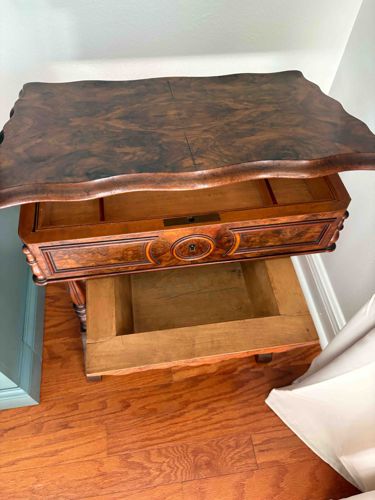
21 x 25 accent table with hidden drawer and articulated lid
These notes were written by the person who submitted this item. Appraiser.AI has not verified them, and the AI's identification and estimate may rely on them.
AI Estimated Value
Not an official valuation
$600-900
AI estimate as of June 25, 2025 · verify with a professional before acting
AI-Generated · Verify before acting
Everything on this page is generated by AI for informational purposes only. AI can make mistakes — the AI may misidentify items or misattribute them (artist, maker, brand, designer, origin, era). This is not an official valuation and should not be used for insurance, sale, tax, estate, legal, or lending purposes — or any decision requiring a certified appraisal. It is not an authoritative claim about any person, brand, or rights holder — do not share or rely on it as a factual statement about a third party. Always consult qualified professionals before making financial decisions.
This analysis also relies on unverified notes provided by the user, which may be incomplete or inaccurate and could affect the result.
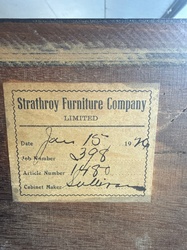
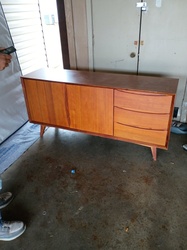
This appears to be an antique or vintage accent table, likely functioning as a console or side table, characterized by its intricately figured wood veneer, possibly burl wood, on the top surface. The table measures approximately 21 x 25 inches, indicating a compact size suitable for smaller spaces. A prominent feature is the hidden drawer, which pulls out from beneath the top surface. This drawer also appears to have an articulated lid, suggesting it might be a pull-out writing surface or a specialized compartment. The drawer facade is highly decorative, featuring marquetry or inlay work with geometric and possibly floral patterns surrounding a central escutcheon for a keyhole. The overall construction exhibits fine craftsmanship, indicative of a formal furniture piece. The legs are not fully visible but appear to be carved or turned. The wood has a rich, medium to dark brown tone with visible grain variations and a polished finish. The top surface shows evidence of age and use with some hairline cracks or separations in the veneer, consistent with natural wood movement over time. The exposed interior of the drawer appears to be a lighter, unfinished wood. No specific maker's marks or signatures are discernible from the image, but the style suggests a European influence, potentially Late Victorian or Edwardian period.
AI Appraisal Report
This accent table, measuring approximately 21 x 25 inches, presents as a charming and functional piece, likely from the Late Victorian or Edwardian period given its style and construction. The rich burl wood veneer top, coupled with the highly decorative marquetry on the hidden drawer facade, indicates a piece of quality craftsmanship. The unique feature of a hidden drawer with an articulated lid adds to its appeal and suggests a specialized function, such as a writing surface or compartment for valuables.Condition-wise, the table shows typical signs of age and use, including prominent hairline cracks or separations in the veneer on the top surface. These are common in natural wood furniture of this age due to expansion and contraction. The exposed, lighter wood inside the drawer suggests an unfinished interior, which is not uncommon. While the overall polished finish appears well-preserved, a physical inspection would be crucial to assess the stability of the veneer, the functionality of the drawer and its articulating mechanism, and the integrity of the joinery.Authenticity is primarily assessed visually; the style, materials, and construction methods align with antique furniture from the stated periods. However, without in-person examination, I cannot definitively confirm the age or rule out later reproductions. My primary limitation is the inability to conduct a tactile examination to assess wood types, joinery techniques, and the presence of any repairs or alterations. Provenance documentation or scientific testing (e.g., carbon dating for wood) would be necessary for full authentication.Market demand for unique, functional antique accent pieces remains steady, especially for those with interesting features like hidden compartments. Pieces with intricate marquetry and quality wood command higher prices. Comparables indicate similar tables with unique functionalities can range significantly based on condition and provenance.The primary factor impacting value is the condition of the veneer and the full functionality of the hidden drawer and articulated lid. Assuming the drawer mechanism works smoothly and the veneer issues are stable, the value holds. If the veneer is loose or the drawer mechanism is faulty, it would negatively impact the appraisal.