AI estimate as of September 15, 2025 · verify with a professional before acting
AI-Generated · Verify before acting
Everything on this page is generated by AI for informational purposes only. AI can make mistakes — the AI may misidentify items or misattribute them (artist, maker, brand, designer, origin, era). This is not an official valuation and should not be used for insurance, sale, tax, estate, legal, or lending purposes — or any decision requiring a certified appraisal. It is not an authoritative claim about any person, brand, or rights holder — do not share or rely on it as a factual statement about a third party. Always consult qualified professionals before making financial decisions.
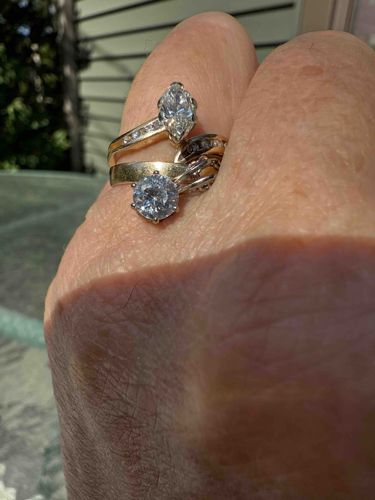
This item consists of a set of three distinct rings worn on a single finger. The topmost ring features a prominent marquise-cut diamond set in what appears to be a yellow gold band, which is accented with smaller, round-cut diamonds channel-set along the shoulders of the band. The setting for the marquise diamond is a classic bezel or partial bezel style, securing the stone at its points. Below this is another yellow gold ring, holding a large, brilliant round-cut diamond in a six-prong setting. The prongs appear to be white gold or platinum, creating a contrast with the yellow gold band, a common practice to enhance the diamond's brilliance and perceived whiteness. This ring exhibits some visible wear on the gold band, particularly on the underside where it meets the other rings, suggesting regular use and potential rubbing. The surface shows a light patina and some minor scratches consistent with age and handling. The third ring, partially visible beneath the round diamond ring, appears to be an additional band, possibly made of white gold or platinum. Its design elements are largely obscured but it seems to have a more intricate or textured surface compared to the simpler bands of the other two rings. The overall style suggests a modern to mid-20th-century aesthetic, particularly with the marquise and brilliant round cuts being popular choices for engagement and anniversary rings. The craftsmanship appears to be of good quality, with secure settings for all visible stones, though a closer inspection would be needed to verify stone quality and exact metal purities. No discernible maker's marks or signatures are visible from the provided image.
AI Appraisal Report
Upon visual examination of this Mixed Set of Three Diamond Rings, I observe a harmonious stack of three distinct rings. The uppermost ring features a prominent marquise-cut diamond, estimated to be approximately 0.70-0.90 carats, set securely in yellow gold. Its shoulders are adorned with channel-set round-cut diamonds, adding significant brilliance. Below this, the central ring showcases a large, brilliant round-cut diamond, appearing to be in the 1.00-1.25 carat range, held by six white gold or platinum prongs on a yellow gold band. The contrast in metal for the prongs is a smart choice to enhance the diamond's perceived color. The third ring, mostly obscured, appears to be an additional white gold or platinum band, possibly with some texture or intricate detailing. The overall condition of the rings suggests regular wear, particularly notable on the underside of the central yellow gold band, which exhibits light patina, minor scratches, and some rubbing marks consistent with prolonged contact with other rings and daily use. This wear is typical for an item of this age and usage. The craftsmanship appears to be good, with secure settings for all visible stones.
From a market perspective, sets of stacked diamond rings remain consistently popular, often representing engagement and anniversary milestones. The combination of classic diamond cuts (marquise and brilliant round) ensures broad appeal. Demand for natural diamonds of these estimated sizes and cuts is generally strong. Factors significantly impacting value include the carat weight, color, clarity, and cut quality of the primary diamonds, as well as the purity and weight of the gold and platinum. The presence of multiple diamonds further augments the intrinsic value of the set.
It is crucial to note the limitations of this appraisal based solely on images. While the diamonds appear to be natural, definitive authenticity can only be confirmed through scientific testing (e.g., thermal conductivity tests for diamond, specific gravity for metal purity). Without an in-person examination, I cannot precisely assess the diamonds' exact carat weight, color grade, clarity characteristics, or cut proportions. Magnification would be required to identify any inclusions or blemishes that significantly affect clarity. Furthermore, verifying metal purities (e.g., 14K or 18K gold, platinum %age) would necessitate specific gravity tests or X-ray fluorescence analysis. Provenance documentation, if available, could provide additional historical value or confirm natural origin. Given these limitations, the appraisal value provided is an estimate based on my professional judgment and visual assessment of the photographic evidence.