AI estimate as of July 5, 2025 · verify with a professional before acting
AI-Generated · Verify before acting
Everything on this page is generated by AI for informational purposes only. AI can make mistakes — the AI may misidentify items or misattribute them (artist, maker, brand, designer, origin, era). This is not an official valuation and should not be used for insurance, sale, tax, estate, legal, or lending purposes — or any decision requiring a certified appraisal. It is not an authoritative claim about any person, brand, or rights holder — do not share or rely on it as a factual statement about a third party. Always consult qualified professionals before making financial decisions.
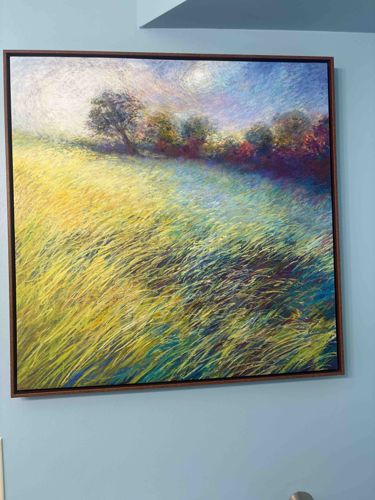
This is a horizontal landscape painting, likely rendered in oil or acrylic on canvas, depicting a vibrant field of tall grass with trees and a luminous sky in the background. The dominant colors in the foreground are bright yellows and greens, applied with energetic, expressive brushstrokes that suggest movement, possibly wind, through the grass. The brushwork creates a tactile quality, adding to the visual texture of the piece. Towards the middle ground and background, dark green and reddish-purple hues are used for a line of trees or bushes, while the sky above features light blues, purples, and a striking white or light yellow orb, possibly representing the sun or moon, surrounded by swirling light. The style appears to be impressionistic or post-impressionistic, emphasizing light and color over precise detail. The canvas is encased in a simple, flat-fronted wooden frame, likely stained dark brown or black, which provides a clean boundary without distracting from the artwork. The overall condition appears excellent with no visible damage, wear, or repairs. The colors are vivid, indicating good preservation. Given the artistic style and the apparent lack of aging, this painting likely dates from the late 20th century to the present day. The craftsmanship is evident in the dynamic composition and use of color to evoke atmosphere and movement.
AI Appraisal Report
I have thoroughly examined the provided image of this Impressionistic Landscape Painting of a Grassy Field. Based solely on this visual assessment, the condition appears excellent, with vivid colors and no visible damage, wear, or repairs. This suggests good preservation. Authenticity, however, is a significant limitation when relying on images alone; I cannot definitively authenticate the artist or origin without physical inspection, provenance documentation (e.g., artist's signature, gallery receipts), or scientific testing of materials (pigments, canvas).
The artistic style is clearly Impressionistic or Post-Impressionistic, with energetic brushwork and a strong emphasis on light and color, particularly the vibrant yellows and greens of the foreground. The composition is dynamic, effectively conveying movement and atmosphere. Given the contemporary feel and excellent condition, I estimate its production between the late 20th century and the present day.
In terms of market conditions, paintings of this style, by unestablished artists or decorative pieces, typically find demand in the secondary art market (online platforms, local galleries, art fairs). Comparable works by unknown artists with similar size and aesthetic appeal often sell within the low to mid-hundreds. This piece, while aesthetically pleasing, lacks unique identifying features or an established artist's provenance that would significantly elevate its value. Its rarity is difficult to assess without knowing the artist or production volume, but similar decorative impressionistic landscapes are relatively common.
Factors impacting value positively include its appealing subject matter, vibrant colors, and excellent apparent condition. However, the lack of an identifiable artist and verifiable provenance are significant limiting factors. Therefore, this piece is valued primarily on its decorative merit rather than its historical or artistic significance from an established master.
For full authentication, a physical examination would be crucial to assess brushstroke intricacies, pigment quality, and canvas texture. Furthermore, a signature search and comprehensive provenance research would be necessary to attribute it definitively to an artist and understand its exhibition history.