AI estimate as of September 20, 2025 · verify with a professional before acting
AI-Generated · Verify before acting
Everything on this page is generated by AI for informational purposes only. AI can make mistakes — the AI may misidentify items or misattribute them (artist, maker, brand, designer, origin, era). This is not an official valuation and should not be used for insurance, sale, tax, estate, legal, or lending purposes — or any decision requiring a certified appraisal. It is not an authoritative claim about any person, brand, or rights holder — do not share or rely on it as a factual statement about a third party. Always consult qualified professionals before making financial decisions.
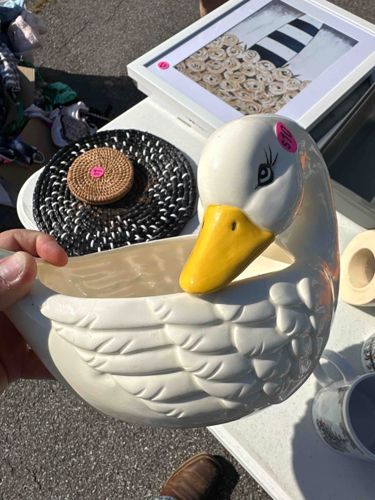
This item is a decorative ceramic piece, molded and glazed to resemble a swan. Its primary color is a creamy white, with a glossy finish, suggesting it is made of glazed earthenware or ceramic. The swan's body forms a hollow vessel, making it suitable for use as a planter or a decorative bowl. Notable features include a bright yellow beak and applied black detailing for the eyes and eyelashes, giving the swan a somewhat whimsical and stylized appearance. The ceramic is sculpted to show feather details on the body, particularly on the 'wings' that form the sides of the bowl, enhancing its realistic yet ornamental quality. The overall construction appears solid, with no visible cracks or chips, indicating good condition. There is a pink 'SALE' sticker affixed to the top of the swan's head, which is a temporary tag and not part of the original manufacturing. The smooth interior of the vessel appears to be unglazed or a lighter, more natural ceramic color. This type of decorative item typically dates from the mid-20th century onwards, often associated with a vintage or country cottage aesthetic due to its charming, somewhat kitschy design. The craftsmanship seems standard for mass-produced ceramic decor of its likely era. No specific maker's marks or signatures are visible in the provided image.
AI Appraisal Report
Having examined the image of this ceramic swan planter/bowl, I assess its condition to be quite good, displaying no visible cracks or significant chips, which is a positive factor. The glossy, creamy white glaze appears intact, and the painted details for the beak, eyes, and eyelashes are clear. The whimsical, stylized design, along with the 'feather' detailing, is characteristic of decorative ceramics from the mid-20th century onwards.
Authenticity, based solely on visual examination, points towards this being a mass-produced decorative item, likely from the vintage period, given its aesthetic. Market conditions for such items tend to be modest. Similar ceramic swan planters, often unmarked, can be found readily in online marketplaces and antique shops, typically ranging from $10 to $40. The 'SALE' sticker is, as noted, temporary and does not affect the item's inherent value.
Demand for these items is generally driven by those seeking nostalgic decor or 'cottagecore' aesthetics, and while steady, it's not high enough to command significant prices. Rarity is not a factor here; countless similar swan planters were produced. The lack of a maker's mark or signature significantly impacts its value, as branded pieces by known manufacturers (e.g., Haeger, Hull) tend to fetch slightly higher prices, though still within a limited range. The unglazed or lighter interior is typical for a planter, preventing potential issues with water retention in glazed areas.
Limitations: Verification of the exact ceramic type (e.g., earthenware, porcelain), manufacturing process, or precise age would necessitate a physical inspection. An in-person examination could also reveal hairline cracks, crazing, or repairs not visible in the image. Provenance documentation, if available, could confirm its history but is unlikely for an item of this type. Scientific testing is not typically applied to items of this value range for authentication.