AI Appraisal Estimate

AI-generated estimates · not official valuations

From the user

What was submitted

Photo and notes provided by the user — not generated by AI

Submitted item photo
Submitted photo · June 6, 2026

User's notes

No additional notes provided.

AI analysis below

AI appraisal

AI analysis & estimate

AI-Generated · Verify before acting

Everything below is generated by AI for informational purposes only. AI can make mistakes — the AI may misidentify items or misattribute them (artist, maker, brand, designer, origin, era). This is not an official valuation and should not be used for insurance, sale, tax, estate, legal, or lending purposes — or any decision requiring a certified appraisal. It is not an authoritative claim about any person, brand, or rights holder — do not share or rely on it as a factual statement about a third party. Always consult qualified professionals before making financial decisions.

Read the full disclaimer

AI Identification

·Not independently authenticated·Verify before acting

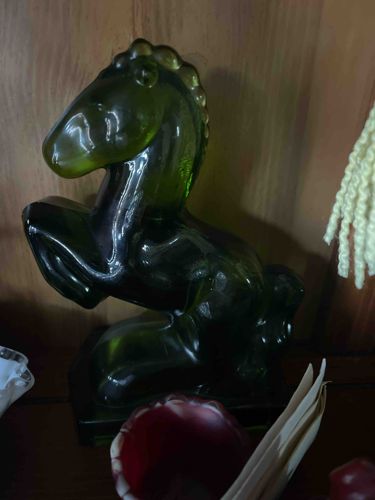
Dark Green Glass Horse Figurine

Decorative Figurine

AI Estimated Value

·Not an official valuation·Verify before acting

$25-45

As of June 6, 2026

AI Item Analysis

·AI can make mistakes·Verify before acting
This item is a decorative figurine crafted from dark green glass, depicting a stylized horse in a rearing or possibly kneeling posture. The glass appears to be molded, indicating a manufacturing process where molten glass was poured into a pre-formed mold. The color is a deep, slightly translucent forest green, which allows some light to pass through, highlighting the contours and thickness variations of the glass. The horse's head is depicted with an elongated snout and small, circular eyes, suggesting a somewhat abstract or impressionistic artistic style rather than photorealistic. A prominent mane is suggested by a series of rounded, bead-like elements along its neck. The body of the horse is stout and muscular, with defined leg shapes, although the overall form is simplified. The base of the figurine is integrated into the horse's body, providing stability. There are no visible chips, cracks, or significant wear on the surface, but the lighting makes it difficult to discern subtle scratches or manufacturing imperfections such as mold lines. The glossy surface reflects light, indicating a smooth, polished finish. Given the typical appearance of such items, it likely dates from the mid-20th century, possibly as a souvenir or decorative piece. The craftsmanship appears to be mass-produced quality, consistent with molded glass techniques of the era. The uniform color and smooth finish suggest a well-controlled manufacturing process.

AI Appraisal Report

·AI can make mistakes·Verify before acting
Based on my visual examination of the provided image, this dark green molded glass horse figurine appears to be in very good condition. I observe no chips, cracks, or significant wear. The glossy surface suggests a well-maintained piece. Authenticity, based on the description, points towards a mass-produced item from the mid-20th century. The stylized design and molded glass technique are consistent with decorative items created during that period. Without a physical inspection, however, I cannot definitively rule out minor manufacturing flaws like mold lines or subtle surface scratches that are common with molded glass. Market conditions for such decorative glass figurines are generally stable but not highly buoyant. Comparables typically include similar vintage molded glass animals from various manufacturers, often sold as decorative accents or souvenirs. Demand for these items is modest, primarily from collectors of vintage glassware or those seeking retro home decor. The piece is not exceptionally rare; mass-produced molded glass was common. Factors impacting value positively include its excellent apparent condition and attractive, consistent coloration. Conversely, its mass-produced nature and lack of a definitive maker's mark or notable provenance limit its upper value potential. For full authentication and a more precise valuation, a direct physical examination is necessary to meticulously check for subtle defects, manufacturing variations, and potential marks or signatures. Provenance documentation, if available, linking it to a specific manufacturer or designer, would significantly enhance authenticity verification and could impact value. Scientific testing, such as spectroscopy, is generally not warranted for items of this type and value range.

Get your items appraised

Instant estimates of your treasures with AI-powered appraisals

Browse More Appraisals