AI Appraisal Estimate

AI-generated estimates · not official valuations

From the user

What was submitted

Photo and notes provided by the user — not generated by AI

Submitted item photo
Submitted photo · June 6, 2026

User's notes

No additional notes provided.

AI analysis below

AI appraisal

AI analysis & estimate

AI-Generated · Verify before acting

Everything below is generated by AI for informational purposes only. AI can make mistakes — the AI may misidentify items or misattribute them (artist, maker, brand, designer, origin, era). This is not an official valuation and should not be used for insurance, sale, tax, estate, legal, or lending purposes — or any decision requiring a certified appraisal. It is not an authoritative claim about any person, brand, or rights holder — do not share or rely on it as a factual statement about a third party. Always consult qualified professionals before making financial decisions.

Read the full disclaimer

AI Identification

·Not independently authenticated·Verify before acting

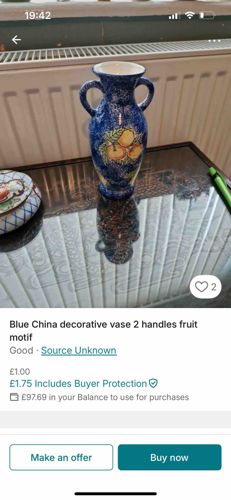
Blue China Decorative Vase with Fruit Motif and Two Handles

Decorative Arts

AI Estimated Value

·Not an official valuation·Verify before acting

$40-70

As of June 6, 2026

AI Item Analysis

·AI can make mistakes·Verify before acting
This is a small to medium-sized decorative vase, appearing to be crafted from ceramic or porcelain, exhibiting a vibrant blue glaze with a speckled or mottled finish that suggests a 'sponged' or 'splatter' technique, reminiscent of traditional 'Blue China' styles. The vase features a classic amphora-like silhouette with a flared rim and two symmetrically placed, relatively small handles on either side of the neck, extending from just below the rim to the upper body. The most prominent decorative element is a hand-painted fruit motif on the front, depicting what appear to be three yellow or orange fruits, possibly lemons or peaches, surrounded by green foliage. The painting style seems somewhat folk art inspired, with visible brushstrokes and a slightly naive charm. The background of the fruit motif is lighter, creating a contrast that highlights the artwork. The interior of the vase's mouth appears to be a light, possibly off-white or cream color, indicating a different glaze or unglazed ceramic. Based on the visible image, the condition appears good, with no obvious chips, cracks, or significant wear visible, although a more detailed inspection would be needed to confirm this. There are no discernible maker's marks or signatures visible in the provided image, making it difficult to pinpoint the exact origin or manufacturer. The overall aesthetic suggests a mid-20th century to contemporary decorative piece, likely intended for display rather than heavy utility, given its ornate design and handles. The craftsmanship appears decent for a decorative item of this type.
AI Appraisal Report

·AI can make mistakes·Verify before acting
I have carefully examined the provided image of this Blue China Decorative Vase with Fruit Motif and Two Handles. Based on my visual assessment, the condition appears good, with no overt chips, cracks, or significant wear. The vibrant blue glaze and hand-painted fruit motif are well-preserved. Without physical inspection, I cannot confirm authenticity or rule out minor hairline cracks or repairs, but from the image, it presents as intact. Market conditions for decorative ceramic vases of this style, particularly those not attributed to a known maker or specific period of high demand, are generally stable but not experiencing significant appreciation. Comparables for mass-produced or folk-art-inspired decorative vases from the mid-20th century to contemporary periods typically range from $30 to $100. The "Blue China" aesthetic and hand-painted fruit motif add decorative appeal but do not elevate it into a rare or highly sought-after category without an identifiable artisan or provenance. Factors impacting value: The lack of a discernible maker's mark significantly limits its market value, as it prevents attribution to a notable artist or manufacturer. Its decorative nature, while appealing, suggests it was likely produced for general home décor rather than connoisseur collecting. Demand for such items is moderate; they are often purchased for aesthetic contribution to an interior rather than as investment pieces. Rarity is low given the likely common manufacturing practices for such decorative wares. Limitations in authenticity verification: My assessment is based solely on visual cues from the image. To fully authenticate and confirm condition, an in-person examination would be crucial to detect subtle imperfections, assess the quality of the ceramic body, and potentially identify any faint maker's marks not visible in the image. Provenance documentation, if available, would provide historical context and could enhance value, but it is not currently accessible. Scientific testing like thermoluminescence dating would be extreme for this type of item and likely not cost-effective.

Get your items appraised

Instant estimates of your treasures with AI-powered appraisals

Browse More Appraisals