These notes were written by the person who submitted this item. Appraiser.AI has not verified them, and the AI's identification and estimate may rely on them.
AI Estimated Value
Not an official valuation
$25-50
AI estimate as of August 10, 2025 · verify with a professional before acting
AI-Generated · Verify before acting
Everything on this page is generated by AI for informational purposes only. AI can make mistakes — the AI may misidentify items or misattribute them (artist, maker, brand, designer, origin, era). This is not an official valuation and should not be used for insurance, sale, tax, estate, legal, or lending purposes — or any decision requiring a certified appraisal. It is not an authoritative claim about any person, brand, or rights holder — do not share or rely on it as a factual statement about a third party. Always consult qualified professionals before making financial decisions.
This analysis also relies on unverified notes provided by the user, which may be incomplete or inaccurate and could affect the result.
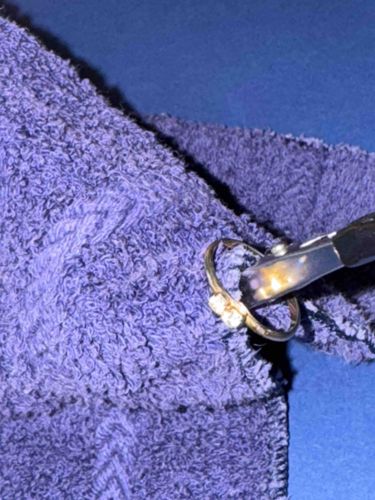
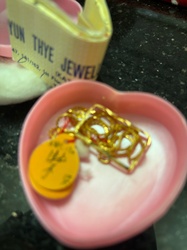
The item appears to be a ring, likely a women's ring, featuring a yellow-toned metal band and set with two seemingly colorless stones. The band is thin and gracefully curved, suggesting a delicate design. Both stones are round brilliant cut, though their exact size and clarity are difficult to ascertain from the image; however, they appear to be of similar size and are prominently displayed on the top of the ring. The stones are set next to each other, creating a 'toi et moi' or bypass style design, where the ends of the band cross over each other to hold the gemstones. The metal of the band shows some signs of wear, indicated by a slight dullness or minor surface scratches, and possible discoloration in areas, which could suggest it is either costume jewelry or a piece with significant use. The appearance of the metal, coupled with the provided context of '18k hge,' indicates it is likely heavy gold electroplate, meaning it has a thin layer of 18 karat gold over a base metal, rather than being solid gold. No visible maker's marks or specific design engravings are discernible from the image. The ring's design suggests it could be from the mid to late 20th century, a period when dual-stone rings were popular. The craftsmanship appears competent for a plated piece, with the settings holding the stones securely. Despite potential wear, the overall structure of the ring seems intact.
AI Appraisal Report
I have examined the image provided of this Two-Stone Bypass Ring, identified as '18k HGE'. Based on my visual assessment, the ring is a delicate bypass-style design featuring two round brilliant cut, seemingly colorless stones set in a yellow-toned metal band. The visual cues of the metal, including slight dullness, minor surface scratches, and potential discoloration, coupled with the '18k HGE' designation, lead me to conclude this is an 18k heavy gold electroplate piece, not solid gold. This significantly impacts its intrinsic value, as the gold content is minimal.
The condition appears fair to good for a plated piece of its likely age (mid-to-late 20th century), with the structure appearing intact despite signs of wear. Authenticity as solid gold cannot be verified; however, its authenticity as an HGE piece is consistent with the visual evidence. The stones appear to be simulants or low-grade natural stones, as is common with plated jewelry; definitive identification would require spectroscopic analysis or gemological examination.
Market conditions for HGE jewelry are generally low, driven by decorative appeal rather than material value. Comparables would include similar vintage gold-plated rings, often found in estate sales or online for modest sums. Demand for such pieces is limited, typically appealing to collectors of vintage costume or plated jewelry. Rarity is not a factor here; HGE jewelry was mass-produced.
The primary factor significantly impacting value is the '18k HGE' designation, meaning it's plated, not solid gold. Other limitations include the inability to definitively identify the stone type, assess clarity or carat weight without physical inspection. Full authentication of stone type, metal composition verification beyond the HGE mark, and precise condition assessment would require in-person examination, specific gravity testing for the metal, and gemological testing for the stones. Without these, the appraisal is based solely on its visual appearance as a decorative, plated item.