AI estimate as of September 22, 2025 · verify with a professional before acting
AI-Generated · Verify before acting
Everything on this page is generated by AI for informational purposes only. AI can make mistakes — the AI may misidentify items or misattribute them (artist, maker, brand, designer, origin, era). This is not an official valuation and should not be used for insurance, sale, tax, estate, legal, or lending purposes — or any decision requiring a certified appraisal. It is not an authoritative claim about any person, brand, or rights holder — do not share or rely on it as a factual statement about a third party. Always consult qualified professionals before making financial decisions.
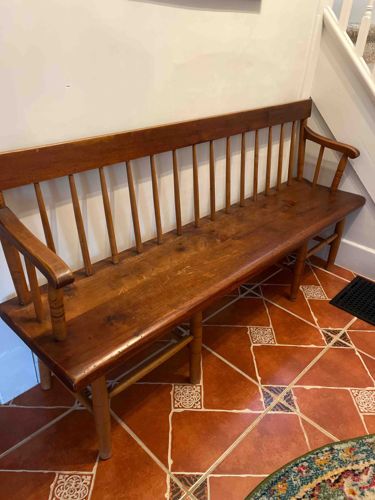
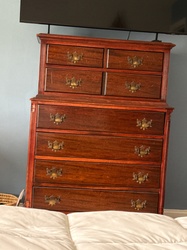
This is a traditional wooden settle bench, crafted from what appears to be a solid hardwood, likely oak or pine, stained to a medium to dark brown hue with visible wood grain patterns. The overall construction suggests a sturdy and functional piece of furniture. It features a long, rectangular seat supported by four turned legs. The backrest is composed of a solid horizontal top rail and numerous vertical spindles, evenly spaced, which are doweled into both the seat and the top rail. Armrests are integrated into the design, extending from the backrest and gently curving downwards to meet the front legs. These armrests are also supported by short, turned spindles connecting them to the seat. The finish shows considerable wear, particularly on the seat and armrests, indicating extensive use. There are noticeable dark spots, surface scratches, and areas where the finish has thinned or discolored, contributing to a rich, aged patina. One or two of the vertical spindles in the backrest might have minor gaps or slightly loose joints, though this is difficult to ascertain definitively from the image. The construction appears to be mortise and tenon or doweled joints, characteristic of older, handcrafted furniture. No specific maker's marks or signatures are visible. The style is reminiscent of early American or Colonial Revival furniture, possibly dating from the late 19th to mid-20th century, which often emphasized simple lines and utilitarian design. The craftsmanship seems solid and practical rather than overtly ornate, suggesting it was built for durability and everyday use. The overall condition, while showing wear, is consistent with a well-loved and regularly used antique or vintage item.
AI Appraisal Report
Based on my visual examination of the provided image, this traditional wooden settle bench appears to be a robust and functional piece. The construction from what seems to be solid hardwood, likely oak or pine, stained to a medium-dark hue, suggests good material quality. The design, featuring turned legs, a spindle backrest, and integrated armrests supported by turned spindles, is characteristic of early American or Colonial Revival styles, placing its probable origin between the late 19th and mid-20th centuries. The craftsmanship, utilizing mortise and tenon or doweled joints, indicates a practical, durable build for everyday use rather than ornate display.
Condition is a significant factor here. The considerable wear on the seat and armrests, visible as dark spots, surface scratches, and thinning/discolored finish, points to extensive use. While these contribute to a desirable aged patina for some collectors, heavier damage could deter others. The potential minor gaps or loose joints in the backrest spindles, though difficult to confirm without physical inspection, would warrant attention and possibly repairs. My assessment of authenticity is based solely on visual cues; the style is consistent with the era, but without maker’s marks or documentation, I cannot definitively confirm its origin or period with 100% certainty from the image alone. In-person examination would be crucial to assess joinery integrity, wood species, and wear patterns more accurately.
Market conditions for such pieces are generally stable, with a moderate demand for well-preserved, utilitarian antique or vintage furniture. Comparables in the market for similar sturdy, unadorned settle benches typically range based on condition, wood quality, and documented provenance. Its lack of overt rarity or highly decorative elements places it in a more accessible segment of the vintage furniture market. Factors impacting value include its solid construction, attractive aged patina despite the wear, and its functional design. The primary limitation in my appraisal is the lack of physical examination; an in-person inspection would allow for tactile assessment of joint stability, accurate identification of wood species, and a closer look for hidden repairs or maker's marks, which could significantly influence the final valuation.