AI estimate as of December 14, 2025 · verify with a professional before acting
AI-Generated · Verify before acting
Everything on this page is generated by AI for informational purposes only. AI can make mistakes — the AI may misidentify items or misattribute them (artist, maker, brand, designer, origin, era). This is not an official valuation and should not be used for insurance, sale, tax, estate, legal, or lending purposes — or any decision requiring a certified appraisal. It is not an authoritative claim about any person, brand, or rights holder — do not share or rely on it as a factual statement about a third party. Always consult qualified professionals before making financial decisions.
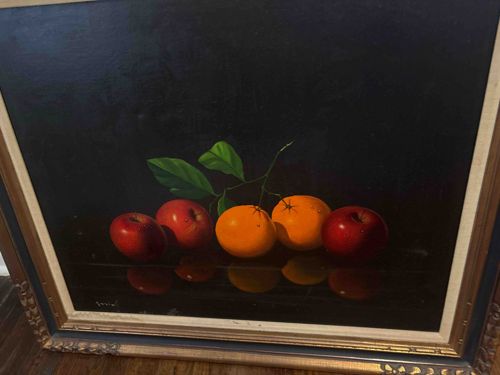
This item is an oil on canvas still life painting depicting four red apples and two oranges, along with a small branch bearing green leaves. The fruits are arranged horizontally across the lower center of the canvas, set against a dark, seemingly black background. The composition features a reflective surface beneath the fruits, creating clear, slightly diffused reflections of each item, complete with visible water droplets on their surfaces, suggesting recent washing or dew. The colors of the fruits are vibrant, with the apples showcasing deep reds and the oranges a bright, warm hue. The green leaves add a contrasting touch of color. The brushwork appears detailed, particularly in rendering the texture and light on the fruit and the delicate water droplets. The painting is housed within an ornate, possibly gilded, wooden frame. The frame features a light-colored inner border, followed by a darker, possibly gold-painted, molded section with classical or floral motifs, and an outermost dark border. A signature, though largely illegible from the provided image, appears to be present in the lower left corner of the canvas. The overall condition appears good, with no obvious signs of significant damage to the painting itself, although the frame shows some minor wear consistent with age, particularly along its edges. The style suggests a realistic or perhaps hyperrealistic approach to still life, with an emphasis on light and texture. Its age is difficult to pinpoint without further information, but it likely dates from the 20th century.
AI Appraisal Report
I have examined the provided image of this oil on canvas still life painting depicting apples and oranges. The composition is well-executed, showcasing vibrant colors and detailed brushwork, particularly in rendering the fruit textures, reflections, and water droplets on a dark background. The reflective surface beneath the fruit adds depth and visual interest. The painting appears to be in good condition, with no visible damage to the canvas or paint layer. The ornate, possibly gilded, wooden frame complements the artwork, though I note some minor wear consistent with age, especially along its edges.
From a market perspective, realistic or hyperrealistic still life paintings, especially those with good technical execution and appealing subject matter like fruit, generally maintain a steady demand. This piece, with its rich detail and warm palette, would likely appeal to collectors of traditional or contemporary realism. Comparables in this category by unlisted or lesser-known artists typically sell in the mid-hundreds to low thousands, depending on size, artist recognition, and exhibition history.
Key factors impacting value include the technical skill evident and the appealing subject matter. The primary limitation to a definitive appraisal is the inability to fully authenticate or attribute the work from an image alone. While a signature is noted in the lower left, its illegibility prevents identification of the artist. For full authentication and a more precise valuation, an in-person examination is crucial to assess the true condition of the paint surface, canvas, stretcher, and frame; analyze brushwork, pigment, and technique up close; and attempt to decipher the signature. Provenance documentation and scientific testing would also be essential to confirm authenticity, origin, and age definitively.