These notes were written by the person who submitted this item. Appraiser.AI has not verified them, and the AI's identification and estimate may rely on them.
AI Estimated Value
Not an official valuation
$5 - $15
AI estimate as of August 2, 2025 · verify with a professional before acting
AI-Generated · Verify before acting
Everything on this page is generated by AI for informational purposes only. AI can make mistakes — the AI may misidentify items or misattribute them (artist, maker, brand, designer, origin, era). This is not an official valuation and should not be used for insurance, sale, tax, estate, legal, or lending purposes — or any decision requiring a certified appraisal. It is not an authoritative claim about any person, brand, or rights holder — do not share or rely on it as a factual statement about a third party. Always consult qualified professionals before making financial decisions.
This analysis also relies on unverified notes provided by the user, which may be incomplete or inaccurate and could affect the result.
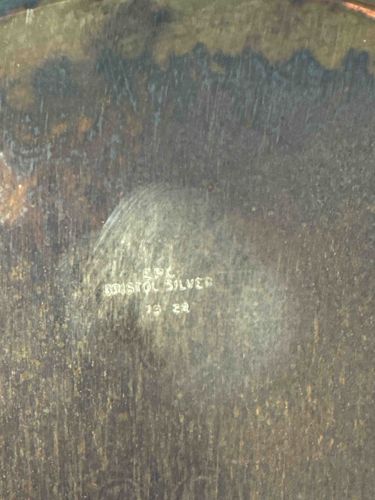
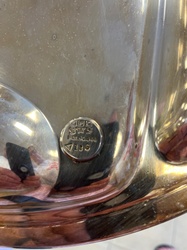
The item appears to be a piece of silverware, specifically indicating 'BRISTOL SILVER' and 'EP' (likely 'Electro-Plated' or 'European Plate') alongside the numbers '73 22'. This suggests that the item is silver-plated rather than solid silver. The surface exhibits a significant amount of tarnish and oxidation, presenting a dark, mottled brown and greyish-green patina across its metallic surface. There are numerous fine scratches and scuffs visible, consistent with wear and prolonged use, indicating its age and history. The overall texture is somewhat uneven due to the tarnish and surface abrasions, suggesting a non-smooth or possibly hammered finish beneath the tarnish or simply the effect of heavy wear. No specific shape or design elements beyond the maker's mark and numbers can be discerned from the image, as it focuses solely on this marked area. The quality of the plating or underlying metal cannot be assessed visually without further cleaning or inspection. The visible condition suggests it has not been recently cleaned or polished, allowing for the natural aging process to occur. Without seeing the full item, it's difficult to ascertain its exact function (e.g., tray, bowl, flatware handle), but the flat, wide appearance could indicate a tray or serving dish. The 'EP BRISTOL SILVER' mark points to a manufacturer or line of silver-plated goods, possibly from the early to mid-20th century, with the numbers '73 22' potentially referring to a pattern number, date code, or inventory number. The craftsmanship appears mass-produced, typical for electroplated items of that era.
AI Appraisal Report
Upon examining the provided image, I can confirm this item bears the "BRISTOL SILVER" and "EP" marks, indicating it is an electro-plated piece, likely from the early to mid-20th century. The 'EP' signifies European Plate or Electro-Plated, meaning it is not solid silver but rather a base metal coated with a thin layer of silver. The numbers '73 22' are most likely a pattern or inventory number for Bristol Silver, a known manufacturer of silver-plated goods. The item exhibits significant tarnish, oxidation, and numerous surface scratches, consistent with prolonged use and age, indicating its actual vintage condition. This heavy patina, while natural, obscures the underlying finish and design. The quality of the plating and the base metal cannot be accurately assessed from the image, nor can the exact function or full form of the item. Without seeing the entire piece, it's challenging to determine its aesthetic appeal or completeness. Due to the mass-produced nature of electro-plated items and the visible wear, the market demand for such pieces is generally low. They often fall into the category of decorative or utilitarian silverware, with value primarily driven by condition, design, and scarcity of a particular pattern or maker. However, "Bristol Silver" items are not inherently rare. Factors significantly impacting value include the lack of a known full form (e.g., a complete tea set vs. just a tray), the general abundance of similar silver-plated wares, and the cost of restoration or cleaning if a buyer desired a polished appearance. The value is largely decorative or scrap. For a full authentication, a physical examination would be necessary to assess the plating thickness, the underlying metal, and any potential repairs or damage not visible in the limited view. Provenance documentation could also enhance value, but it's rarely available for such items. Without these, the appraisal is limited to the visual information provided.