Cedar chest waterfall lid unbranded mohagany stain
These notes were written by the person who submitted this item. Appraiser.AI has not verified them, and the AI's identification and estimate may rely on them.
AI Estimated Value
Not an official valuation
$150-300
AI estimate as of November 29, 2025 · verify with a professional before acting
AI-Generated · Verify before acting
Everything on this page is generated by AI for informational purposes only. AI can make mistakes — the AI may misidentify items or misattribute them (artist, maker, brand, designer, origin, era). This is not an official valuation and should not be used for insurance, sale, tax, estate, legal, or lending purposes — or any decision requiring a certified appraisal. It is not an authoritative claim about any person, brand, or rights holder — do not share or rely on it as a factual statement about a third party. Always consult qualified professionals before making financial decisions.
This analysis also relies on unverified notes provided by the user, which may be incomplete or inaccurate and could affect the result.
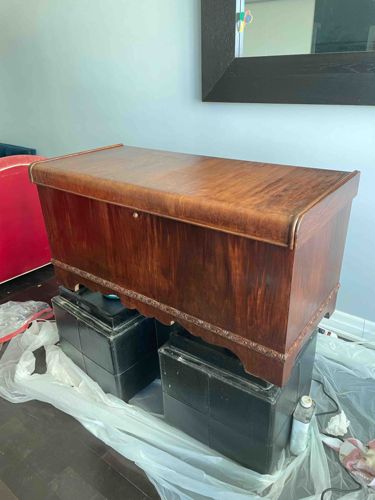
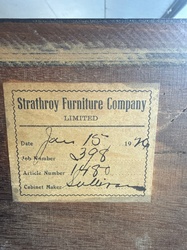
This appears to be an Art Deco cedar chest featuring a distinctive waterfall lid design. The chest is constructed from wood, likely a secondary wood for the main body, finished with a mahogany stain, as indicated by the user-provided context. The finish exhibits a reddish-brown hue with visible wood grain patterns, suggesting a veneer over solid construction, which was common for the period. The 'waterfall' detail is evident in the gracefully rounded, continuous top surface that curves over the front edge, a hallmark of Art Deco furniture. The chest displays what appears to be a scalloped or carved trim along the bottom edge of the front, adding a decorative element. A small, circular keyhole is visible on the front panel, indicating a locking mechanism. The overall condition suggests some wear consistent with age, including potential fading, minor scratches, or imperfections in the finish, particularly noticeable on the lid and front panel, which may indicate a need for refinishing or restoration. While specific dimensions are not provided, it appears to be a standard size for a blanket chest. There are no discernible maker's marks or signatures visible in the provided images. The craftsmanship appears sturdy, typical of furniture from its estimated age, which would generally fall between the 1920s and 1940s. The piece is currently elevated on two black, cube-like risers, with plastic sheeting underneath, possibly indicating preparation for cleaning or restoration.
AI Appraisal Report
Upon examining the provided image and description, I've assessed this Art Deco waterfall lid cedar chest. It presents characteristic features of the period, notably the continuous, rounded top edge and the decorative scalloped trim along the bottom front, all finished in a mahogany stain. The visible wood grain suggests a veneer over a secondary wood construction, typical for such pieces from the 1920s to 1940s. The presence of a keyhole indicates a locking mechanism, a common feature of cedar chests.
In terms of condition, the chest shows wear consistent with its age. I observe what appears to be fading, minor scratches, and imperfections in the finish, particularly on the lid and front panel. While sturdy, these cosmetic issues suggest a need for refinishing or restoration to achieve its full aesthetic potential. The chest's elevation on risers and the plastic sheeting might indeed indicate preparation for such work.
Market conditions for unbranded Art Deco cedar chests are generally moderate. While the style is sought after, a piece requiring restoration, coupled with the lack of a known manufacturer or exceptional rarity, positions it at the accessible end of the market. Comparables often include similar chests in varying conditions, with restored examples fetching higher prices.
Demand is steady for functional and aesthetically pleasing vintage furniture, but rarity is not a significant factor here as waterfall chest designs were mass-produced. The primary factors impacting its current value are the unbranded nature and the visible wear. Its functionality as a cedar chest does add intrinsic value.
It is crucial to state that this appraisal is based solely on visual examination of images and provided textual context. I cannot definitively verify the authenticity of materials (e.g., if it is solid cedar interior throughout) or the exact age without an in-person examination. A physical inspection would allow me to assess the structural integrity, identify any repairs or alterations, confirm wood types, and potentially uncover hidden maker's marks or labels. Scientific testing, while usually beyond the scope for such an item, could precisely date the wood or finishes if required for absolute authentication (e.g., in a dispute over age). Without these, the origin and specific composition remain an informed estimation.