These notes were written by the person who submitted this item. Appraiser.AI has not verified them, and the AI's identification and estimate may rely on them.
AI Estimated Value
Not an official valuation
$400-600
AI estimate as of July 7, 2025 · verify with a professional before acting
AI-Generated · Verify before acting
Everything on this page is generated by AI for informational purposes only. AI can make mistakes — the AI may misidentify items or misattribute them (artist, maker, brand, designer, origin, era). This is not an official valuation and should not be used for insurance, sale, tax, estate, legal, or lending purposes — or any decision requiring a certified appraisal. It is not an authoritative claim about any person, brand, or rights holder — do not share or rely on it as a factual statement about a third party. Always consult qualified professionals before making financial decisions.
This analysis also relies on unverified notes provided by the user, which may be incomplete or inaccurate and could affect the result.
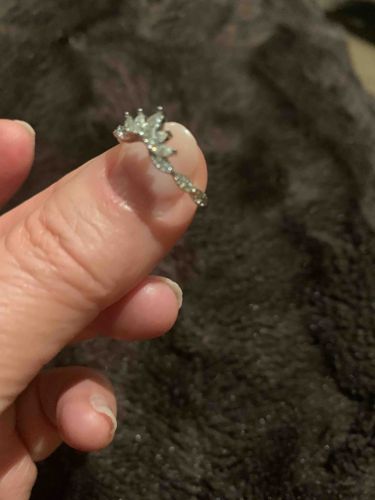
This is a silver-toned ring, likely made of sterling silver, white gold, or platinum, or a plated base metal. The ring features a tiara or crown-like design on the top, composed of multiple clear, faceted gemstones. Given the provided context of 'Moissanite,' it is highly probable that these stones are moissanite, which are known for their brilliance and durability, often used as diamond simulants. The upper part of the ring's band is set with a series of marquise-cut and perhaps some round brilliant-cut stones, arranged in a scalloped or floral pattern, creating a delicate and elegant aesthetic. The stones are prong-set, which allows maximum light to enter them. The lower part of the band tapers and is also set with smaller, round brilliant-cut stones, extending around approximately one-quarter to one-third of the circumference, providing additional sparkle. The craftsmanship appears to be fine, with well-aligned settings and a polished finish. The ring's condition appears very good, with no visible signs of significant wear, damage, or missing stones. The metal shows a bright, reflective surface. The overall style suggests a modern or contemporary design, possibly intended as an engagement ring, wedding band, or a fashion accessory. Its delicate structure and sparkling stones indicate a focus on elegance and visual appeal. There are no discernible maker's marks or signatures visible from the image, which would typically be located on the interior of the band. The ring's small size, as indicated by its placement on a finger, suggests it is likely a standard women's ring size.
AI Appraisal Report
Based on my visual examination of the Moissanite Crown/Tiara Style Ring, its condition appears very good, showing no signs of significant wear, damage, or missing stones. The metal has a bright, reflective surface, indicative of good care. Given the owner's description, the gemstones are presumed to be moissanite, a durable and brilliant diamond simulant. Authentication of the stones as moissanite versus other simulants or even low-grade diamonds would require a jeweler's loupe, thermal conductivity testing, and possibly a diamond/moissanite tester. The metal's precise composition (sterling silver, white gold, or platinum) cannot be definitively determined from an image; this would necessitate hallmark inspection or metal testing.
From a market perspective, moissanite jewelry offers excellent value compared to natural diamonds while maintaining a similar aesthetic appeal. This particular tiara/crown style is popular for its delicate and elegant design, suitable as an engagement piece, wedding band, or fashion accessory. The absence of visible maker’s marks limits the ability to tie the piece to a known brand, which could potentially increase value. Factors impacting value include the total carat weight of the moissanite, the purity of the metal, and the quality of craftsmanship. Without physical inspection to verify these details, the valuation is based on similar items available in the mass market for moissanite jewelry. Rarity is low as moissanite is synthetically produced.
For full authentication of the stones and metal, an in-person examination would be crucial. This would allow for detailed inspection under magnification, specific gravity tests, and potentially spectroscopic analysis for definitive stone identification. Provenance documentation, if available, would also add to the item's verifiable history. Without these, my appraisal is limited to visual assessment and general market comparables for moissanite jewelry.