AI estimate as of October 4, 2025 · verify with a professional before acting
AI-Generated · Verify before acting
Everything on this page is generated by AI for informational purposes only. AI can make mistakes — the AI may misidentify items or misattribute them (artist, maker, brand, designer, origin, era). This is not an official valuation and should not be used for insurance, sale, tax, estate, legal, or lending purposes — or any decision requiring a certified appraisal. It is not an authoritative claim about any person, brand, or rights holder — do not share or rely on it as a factual statement about a third party. Always consult qualified professionals before making financial decisions.
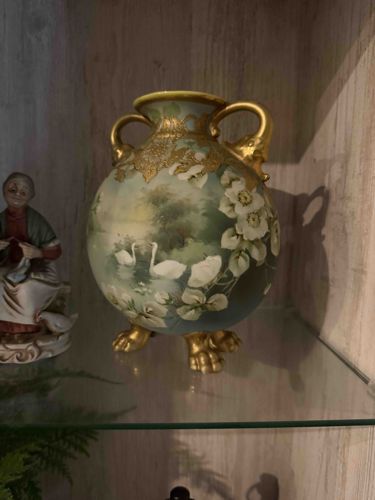
This item is an ornate porcelain vase, likely dating from the late Victorian to early 20th century period, showcasing considerable decorative artistry. The vase features a globular body, supported by three distinct gilded feet shaped like lion's paws or similar mythical animal claws. Two C-scroll handles, also gilded, adorn the neck, extending from the rim and attaching to the upper shoulder of the vase. The primary color palette is a serene light blue-green, transitioning subtly in the background to create a landscape scene. The main body of the vase is extensively hand-painted with a naturalistic motif: a pair of white swans gracefully swimming on a body of water, surrounded by lush green foliage. Dominant white flowers, possibly dogwood or camellias, with delicate green leaves, are painted on the foreground, extending around a significant portion of the vase's circumference. The neck and shoulders of the vase are decorated with elaborate raised gilt enamel work, depicting intricate rococo-style scrollwork and floral accents, providing a rich contrast to the painted scenes. The overall style suggests a sophisticated, decorative piece, indicative of fine porcelain craftsmanship, possibly German, French, or American manufacture. There are no visible chips, cracks, or repairs from the image, and the gilding appears largely intact, though some minimal wear consistent with age and handling might be present. The intricate detail in the painting and the raised gilding suggest a high level of craftsmanship and artistic skill, making it a desirable decorative art object.
AI Appraisal Report
Based on my visual examination of the provided image, this ornate porcelain tripod vase exhibits characteristics consistent with late Victorian to early 20th-century decorative arts. The hand-painted swan and floral motif on a serene blue-green ground, coupled with the elaborate raised gilt enamel work, C-scroll handles, and gilded lion's paw feet, all point to a high-quality manufacture. The condition appears excellent from the image; I detect no obvious chips, cracks, or repairs. The gilding seems largely intact, which is crucial for such pieces.
Market conditions for such decorative porcelain vases, especially those with intricate hand-painting and untouched gilding, generally remain steady. Comparable items from European manufacturers (German, French) or high-end American potteries (like Lenox or Pickard) with similar craftsmanship and condition trade in the mid-to-high hundreds, sometimes exceeding $1,000 for exceptional examples or those with strong provenance. The combination of artistry, good condition, and decorative appeal contributes to its value. Demand is consistent among collectors of period decorative arts.
Key factors impacting value include the quality of the hand-painting, the intricacy and intactness of the raised gilding, and the overall condition. The absence of maker's marks is a limiting factor for precise valuation without in-person inspection.
It is important to note that my assessment is based solely on the image. For full authentication and a definitive valuation, I would require a physical examination to check for any hairline cracks, professional repairs not visible in photos, wear to the gilding, and to locate any maker's marks or artist signatures. Authentication of the period and origin would also benefit from provenance documentation or scientific testing of the porcelain body and glazes.