These notes were written by the person who submitted this item. Appraiser.AI has not verified them, and the AI's identification and estimate may rely on them.
AI Estimated Value
Not an official valuation
$75 - $125
AI estimate as of August 31, 2025 · verify with a professional before acting
AI-Generated · Verify before acting
Everything on this page is generated by AI for informational purposes only. AI can make mistakes — the AI may misidentify items or misattribute them (artist, maker, brand, designer, origin, era). This is not an official valuation and should not be used for insurance, sale, tax, estate, legal, or lending purposes — or any decision requiring a certified appraisal. It is not an authoritative claim about any person, brand, or rights holder — do not share or rely on it as a factual statement about a third party. Always consult qualified professionals before making financial decisions.
This analysis also relies on unverified notes provided by the user, which may be incomplete or inaccurate and could affect the result.
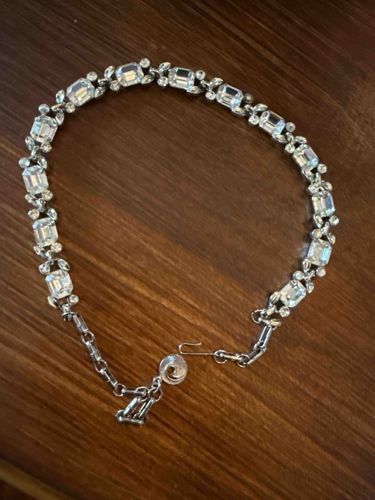
This item is a vintage-style choker necklace featuring clear faceted stones set in a silver-toned metal. The necklace is composed of alternating segments: rectangular emerald-cut clear stones and smaller, round clear stones arranged in a floral or leaf-like cluster. The rectangular stones are prominently set, likely in a bezel or prong setting that is not clearly visible due to the reflective nature of the stones and the angle. The smaller stones, possibly chatons, surround the larger stones in groups of three or four, forming decorative links. The overall construction appears to be a series of hinged or articulated links, allowing the necklace to conform to the neck. The metal has a consistent silver tone, suggesting it could be rhodium-plated base metal, pot metal, or another silver-colored alloy, especially given the context of "no metal marking." There are no visible signs of significant wear or surface scratches on the stones. The metal shows some minor surface wear consistent with age and use, but no heavy tarnishing or obvious pitting. The clasp mechanism is a hook-and-eye closure, common in vintage costume jewelry, and includes an extender chain for adjustable length. A small, decorative charm or tag, possibly a manufacturer's mark or simply an embellishment, is attached near the clasp, though specific details are indiscernible. The craftsmanship appears to be of good quality for costume jewelry of its era, with stones well-seated and a sturdy clasp. Given its construction and style, it likely dates to the mid-20th century, possibly the 1950s or 1960s, reflecting a period when elaborate crystal jewelry was popular.
AI Appraisal Report
Based on my examination of the provided image and information, this choker necklace is a well-preserved example of mid-20th century costume jewelry. The clear faceted stones, alternating between emerald-cut and floral clusters, are clean and show no significant chips or scratches. The silver-toned metal, though lacking hallmarks, appears to be in good condition with minor surface wear consistent with age, but no heavy tarnishing or pitting. The hook-and-eye clasp with extender chain is functional and typical for the era.
This piece's authenticity as a vintage costume item is high given its style, construction (articulated links, claw/bezel settings), and the common absence of metal markings on pieces of this type and period. The craftsmanship, while not fine jewelry grade, is sturdy for costume, indicating good production quality.
In terms of market conditions, vintage crystal chokers, especially those without designer attribution or precious metals/gems, fall into an accessible price range. Demand is stable among collectors of vintage costume jewelry and those seeking period-appropriate accessories. Rarity is not a significant factor here; while unique in its specific configuration, similar styles of crystal necklaces were mass-produced. Factors impacting value include the excellent condition of the stones and the intact plating. The lack of metal markings and specific maker identification prevents it from commanding higher prices associated with signed pieces like those by Eisenberg, Schreiner, or Swarovski, which could fetch significantly more.
Limitations in authenticity verification from images alone include the inability to definitively determine the metal composition (e.g., pot metal vs. rhodium-plated base metal) or the exact material of the 'crystal' (e.g., glass vs. high-lead glass). An in-person examination would allow for precise material testing, direct inspection for microscopic wear or repairs, and a more thorough evaluation of the clasp security. Provenance documentation (e.g., original receipts, known history of ownership) would also enhance value and confirm its historical context.