These notes were written by the person who submitted this item. Appraiser.AI has not verified them, and the AI's identification and estimate may rely on them.
AI Estimated Value
Not an official valuation
$75 - $125
AI estimate as of November 6, 2025 · verify with a professional before acting
AI-Generated · Verify before acting
Everything on this page is generated by AI for informational purposes only. AI can make mistakes — the AI may misidentify items or misattribute them (artist, maker, brand, designer, origin, era). This is not an official valuation and should not be used for insurance, sale, tax, estate, legal, or lending purposes — or any decision requiring a certified appraisal. It is not an authoritative claim about any person, brand, or rights holder — do not share or rely on it as a factual statement about a third party. Always consult qualified professionals before making financial decisions.
This analysis also relies on unverified notes provided by the user, which may be incomplete or inaccurate and could affect the result.
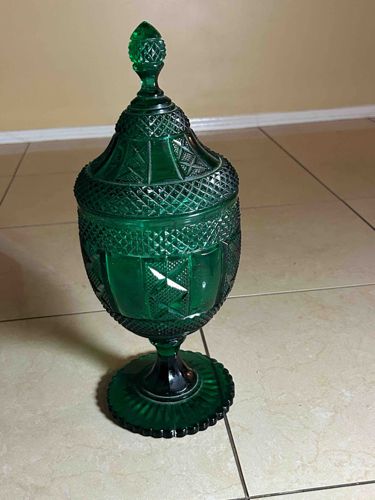
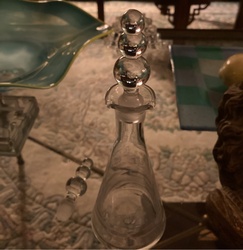
This item is a vibrant emerald green glass covered candy dish, identified by the context as 'Huguenot Royale White'. It features an elaborate pressed glass pattern, indicative of early to mid-20th-century glassware. The dish consists of two main parts: a footed bowl and a fitted lid, both crafted from deeply colored translucent green glass. The bowl sits on a flared circular base, which is also patterned with what appears to be fluting or radial lines and a scalloped edge. The body of the bowl showcases a combination of complex geometric patterns, including diamond-cut motifs and areas of starburst or hobnail designs, creating a multifaceted surface that catches and reflects light. A distinct feature towards the top of the bowl and on the lid is a band of cross-hatching or basketweave pattern. The lid itself mirrors the intricate designs of the bowl, tapering upwards to a decorative finial. This finial is also faceted and diamond-cut, culminating in a pointed top, serving both as an aesthetic element and a practical handle for removing the lid. The glass appears to be in excellent condition with no visible cracks, chips, or significant scuffs, maintaining its original glossy finish. The craftsmanship suggests a production method involving casting or pressing, achieving detailed designs that are characteristic of collectible glassware from the Depression Era or slightly later periods. The deep green hue is consistent throughout, suggesting a uniform manufacturing process. The overall design evokes an elegant and somewhat ornate aesthetic, typical of pieces intended for display or special occasion use.
AI Appraisal Report
I have examined the provided images of this Huguenot Royale White emerald green glass covered candy dish. Visually, the piece appears to be in excellent condition, showing no visible cracks, chips, or significant scuffs, and maintaining a good, glossy finish. The intricate pressed glass patterns, including diamond-cut motifs, starburst/hobnail designs, and basketweave banding, are characteristic of early to mid-20th-century glassware, especially during the Depression-era. The deep, uniform green hue further supports its period authenticity as a manufactured item.
Market comparables for similar Depression-era or vintage pressed glass candy dishes in distinctive colors and elaborate patterns generally fall within the $50-$150 range. Pieces by well-known manufacturers or in particularly rare patterns can command higher prices. Demand for decorative glassware like this remains steady among collectors of vintage glass, especially for pieces in excellent condition and attractive colors like this vibrant green. While not exceedingly rare, its condition and detailed design contribute to its appeal.
Factors significantly impacting its value include its pristine condition, the attractive and consistent color, and the detailed, well-executed pressed glass pattern. The 'Huguenot Royale White' designation suggests a specific pattern or line, which can aid in precise identification and valuation if provenance can be established.
It is crucial to note that this appraisal is based solely on visual examination of the provided images. Without a physical inspection, I cannot definitively confirm authenticity, assess subtle flaws like internal stress fractures, pinpoint exact manufacturing methods, or verify the glass composition. An in-person examination would allow me to check for manufacturer’s marks (if any), assess the weight and feel of the glass, and scrutinize the condition under various lighting conditions. Provenance documentation, such as original sales receipts or catalog references, would further solidify its authenticity and potentially its value history.