AI estimate as of July 6, 2025 · verify with a professional before acting
AI-Generated · Verify before acting
Everything on this page is generated by AI for informational purposes only. AI can make mistakes — the AI may misidentify items or misattribute them (artist, maker, brand, designer, origin, era). This is not an official valuation and should not be used for insurance, sale, tax, estate, legal, or lending purposes — or any decision requiring a certified appraisal. It is not an authoritative claim about any person, brand, or rights holder — do not share or rely on it as a factual statement about a third party. Always consult qualified professionals before making financial decisions.
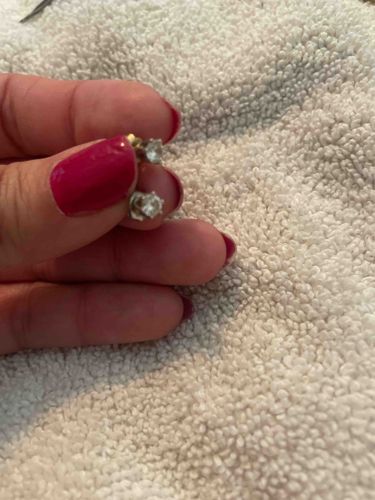
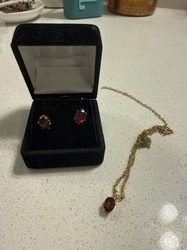
The item appears to be a pair of stud earrings, each featuring a single, round faceted gemstone. The gemstones are colorless and transparent, consistent with diamonds or diamond simulants such as cubic zirconia or moissanite. Given the visual information, it is not possible to definitively determine the exact material of the stones. Each stone is set in what appears to be a four-prong basket setting, likely crafted from a white metal, possibly silver, white gold, or platinum, judging by its reflective, silvery hue. There is a visible yellow-toned element at the back of one of the settings, which might suggest a gold post or a contrast in metal color for the earring findings, though this is not entirely clear. The overall size of the stones appears to be moderate, likely ranging from 0.25 to 0.75 carat equivalent per stone, based on their visual proportion to the fingers holding them. The settings seem to be robust, holding the stones securely. There are no obvious signs of significant damage like bent prongs or missing stones. The metal shows a general sheen consistent with polished jewelry, with no major visible scratches or tarnishing from this distance. Manufacturer's marks or hallmarks, which would typically be on the posts or backs, are not discernible from the image. These earrings likely date from the late 20th century to contemporary, as a classic and timeless design. The craftsmanship appears to be standard for mass-produced or semi-custom jewelry, focusing on secure stone setting and a clean finish.
AI Appraisal Report
Upon visual examination of the provided image, I assess this pair of gemstone stud earrings. The condition appears to be good, with no obvious damage such as bent prongs or missing stones. The metal displays a general sheen, indicative of a polished finish with no major visible scratches or tarnishing. Authenticity, however, is limited by image-only assessment. The colorless, transparent gemstones could be diamonds, moissanite, or cubic zirconia. Without in-person examination, specifically scientific testing like thermal conductivity tests or spectroscopy, it's impossible to definitively confirm the gemstone material. Similarly, the white metal setting, while appearing robust, cannot be definitively identified as silver, white gold, or platinum without hallmarks or metal testing. The visible yellow-toned element on the back of one setting would require in-person inspection to determine if it indicates a different metal for the post or merely a reflection.
Market conditions for classic stud earrings are generally stable, driven by consistent demand for versatile, everyday jewelry. Comparables would range widely based on gemstone identity: true diamond studs would command significantly higher prices than moissanite or CZ. Factors significantly impacting value include gemstone type, carat weight (estimated here at 0.25-0.75 carat equivalent per stone), metal purity, and any discernible brand or designer. If these are indeed diamond studs of decent quality, the value would be substantially higher; if they are simulants, the value would be modest, primarily reflecting the metal content and labor. Rarity for this classic design is low as it is widely produced. For full authentication and accurate valuation, a physical examination is crucial to identify gemstone and metal composition, assess cut quality and clarity, and identify any hallmarkings.