These notes were written by the person who submitted this item. Appraiser.AI has not verified them, and the AI's identification and estimate may rely on them.
AI Estimated Value
Not an official valuation
$600-900
AI estimate as of July 25, 2025 · verify with a professional before acting
AI-Generated · Verify before acting
Everything on this page is generated by AI for informational purposes only. AI can make mistakes — the AI may misidentify items or misattribute them (artist, maker, brand, designer, origin, era). This is not an official valuation and should not be used for insurance, sale, tax, estate, legal, or lending purposes — or any decision requiring a certified appraisal. It is not an authoritative claim about any person, brand, or rights holder — do not share or rely on it as a factual statement about a third party. Always consult qualified professionals before making financial decisions.
This analysis also relies on unverified notes provided by the user, which may be incomplete or inaccurate and could affect the result.
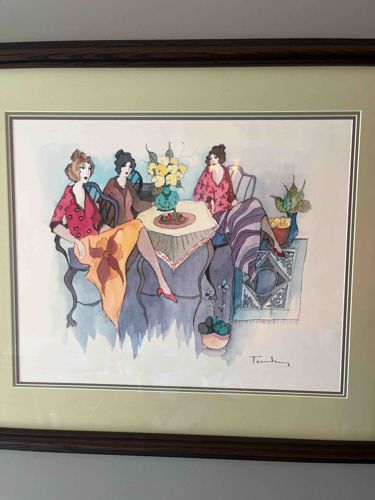
This appears to be a framed art piece, very likely a print or possibly an original watercolor, given the medium's typical appearance for Itzchak Tarkay. The artwork depicts four stylized women gathered around a round table, seemingly engaged in a social setting. The dominant colors are soft pastels and muted tones, including mauves, peach, brown, purples, and blues, with vibrant accents such as the red shoes and the yellow flowers in a teal vase. The figures are rendered with thick outlines, characteristic of Tarkay's expressive style, and exhibit flat areas of color washes. The women are adorned in patterned dresses, with one on the left in red polka dots, another in a brown solid, a third in a pink geometric pattern, and the fourth in striking purple and white stripes. A signature, discernible as 'Tarkay,' is present in the lower right corner, confirming the artist as Itzchak Tarkay. The piece is set within a multi-layered matting system, featuring a narrow dark inner mat and a wider light green outer mat, which provides a pleasing contrast to the artwork's palette. This is then housed in a dark brown, possibly wood, frame with a simple profile. The overall condition appears good, with no visible damage to the artwork itself, although minor dust collection or superficial scratches might be present on the frame or glass due to age and handling. The style is distinctly Post-Impressionistic with a blend of figurative and decorative elements, typical of Tarkay's work from the late 20th or early 21st century. The quality of the framing suggests a professional presentation. The craftsmanship in the print reproduction (if it is a print) is of high quality, retaining the nuances of the original watercolor medium.
AI Appraisal Report
Upon examining the provided image and description of the 'Gathering of Four Women' attributed to Itzchak Tarkay, my assessment is as follows. The artwork's style, color palette, and signature are highly consistent with Tarkay's known body of work, particularly his Post-Impressionistic figurative pieces from the late 20th/early 21st century. The described thick outlines and flat color washes are hallmarks of his technique. The overall condition appears good, with no visible damage to the artwork itself. The professional multi-layered matting and dark frame enhance its presentation.
Market conditions for Tarkay's prints, especially serigraphs, are generally stable, with a wide range of prices depending on edition size, subject matter, and rarity. While demand is steady for his prints, true rarity is typically associated with unique works or smaller limited editions. This piece, if a high-quality print (such as a serigraph), would fall into the mid-range of his secondary market offerings. Factors impacting value include whether this is an open edition print, a limited edition print, or potentially an original watercolor. The description suggests it could be a print due to 'reproduction quality,' but also hints at watercolor characteristics. If it is an original watercolor, the value would be significantly higher.
Limitations in authenticity verification from images alone are notable. While the visible signature and style are persuasive, definitive authentication requires in-person examination to verify medium (print type vs. original watercolor), examine the paper, and scrutinize the signature for pressure and ink characteristics. Provenance documentation (certificate of authenticity, gallery receipts) is crucial to establishing authenticity and ownership history. Scientific testing, such as pigment analysis, would be necessary for ultimate confirmation of an original work. Without these, it's difficult to ascertain if this is an original work, a serigraph, or another form of print, which significantly impacts value.