AI estimate as of August 1, 2025 · verify with a professional before acting
AI-Generated · Verify before acting
Everything on this page is generated by AI for informational purposes only. AI can make mistakes — the AI may misidentify items or misattribute them (artist, maker, brand, designer, origin, era). This is not an official valuation and should not be used for insurance, sale, tax, estate, legal, or lending purposes — or any decision requiring a certified appraisal. It is not an authoritative claim about any person, brand, or rights holder — do not share or rely on it as a factual statement about a third party. Always consult qualified professionals before making financial decisions.
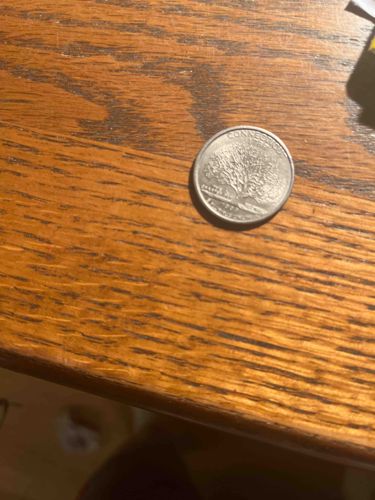
The item depicted is a United States quarter, specifically a State Quarter from the 50 State Quarters Program. This particular coin appears to be the Connecticut State Quarter, indicated by the word 'CONNECTICUT' visible along the top edge of the coin's design on the obverse side. The central design element on this side is a large, mature oak tree, which is the 'Charter Oak' of Connecticut. The tree is depicted with a detailed canopy and trunk, firmly rooted. Below the tree, the year '1788' and '1999' are visible, signifying the year Connecticut ratified the U.S. Constitution and the year this coin was minted. There is also a small inscription that appears to be 'The Charter Oak'. The coin is circular and made of a metallic material, consistent with the standard clad composition for U.S. quarters (copper-nickel clad copper). Its color is a typical silver-grey. The surface of the coin shows some signs of circulation, with a slight dulling of the luster and minor surface scratches, but no significant damage like deep gouges or bends are apparent. The relief of the design elements remains clear and distinct, indicating good circulation quality. The craftsmanship is consistent with mass-produced coinage from the United States Mint. The coin's edge, though not fully visible, is expected to be reeded. The overall condition suggests that it is a circulated coin but well-preserved.
AI Appraisal Report
After a thorough visual examination of the provided image of the Connecticut State Quarter (Charter Oak), I can offer the following appraisal. Based on its appearance, this coin is undoubtedly an authentic United States quarter from the 50 State Quarters Program. The design elements, including the Charter Oak, the 'CONNECTICUT' inscription, and the dates '1788' and '1999', are consistent with the known specifications for this issue. The craftsmanship is typical of mass-produced coinage from the U.S. Mint.
In terms of condition, the coin appears to be in circulated condition, likely falling into the Very Fine (VF) to Extremely Fine (XF) range. While some dulling of luster and minor surface abrasions are visible, the major design elements remain clear and distinct, without significant wear on the high points. There are no signs of major damage such as bends, scratches, or corrosion that would severely impact its value.
From a market perspective, standard circulated Connecticut State Quarters are extremely common. The 1999 Connecticut quarter had a very high mintage, preventing any inherent rarity for typical examples. Demand for common circulated state quarters is primarily at face value. While collectors may seek uncirculated or high-grade examples, a circulated specimen like this primarily holds its sentimental or educational value rather than significant numismatic premium.
Factors that significantly impact value, such as rare errors, varieties, or exceptional uncirculated condition (MS-60 or higher), are not evident from the image. If this coin were a certified error coin or in pristine, uncirculated condition, its value would be considerably higher.
Therefore, considering the common nature of this coin and its circulated condition, its numismatic value above face value is minimal.
Limitations: My assessment of authentication and condition is based solely on the provided image. For full authentication and a precise grade, an in-person examination by a professional numismatist is essential. This would allow for a detailed inspection of the coin's luster, surface integrity, edge, and other microscopic details that can confirm authenticity, detect subtle errors or varieties, and precisely determine its Sheldon grade. Provenance documentation, while not usually relevant for modern circulating coinage, would be helpful for truly rare or high-value pieces.