AI Appraisal Estimate

AI-generated estimates · not official valuations

From the user

What was submitted

Photo and notes provided by the user — not generated by AI

Submitted item photo
Submitted photo · June 15, 2026

User's notes

No additional notes provided.

AI analysis below

AI appraisal

AI analysis & estimate

AI-Generated · Verify before acting

Everything below is generated by AI for informational purposes only. AI can make mistakes — the AI may misidentify items or misattribute them (artist, maker, brand, designer, origin, era). This is not an official valuation and should not be used for insurance, sale, tax, estate, legal, or lending purposes — or any decision requiring a certified appraisal. It is not an authoritative claim about any person, brand, or rights holder — do not share or rely on it as a factual statement about a third party. Always consult qualified professionals before making financial decisions.

Read the full disclaimer

AI Identification

·Not independently authenticated·Verify before acting

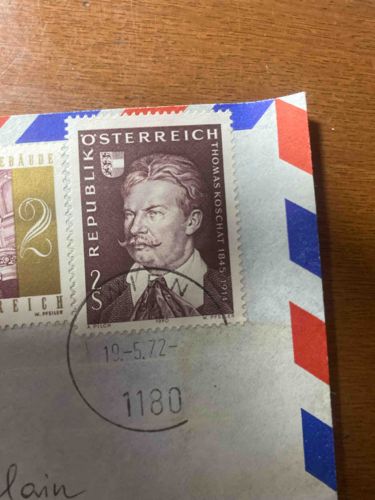
Austrian Thomas Koschat Postage Stamp on Air Mail Envelope

Philatelic Collectible

AI Estimated Value

·Not an official valuation·Verify before acting

$5-15

As of June 15, 2026

AI Item Analysis

·AI can make mistakes·Verify before acting
This item is an Austrian postage stamp featuring a portrait of Thomas Koschat, affixed to an air mail envelope. The stamp itself is rectangular, with serrated edges typical of postal stamps. It primarily features a dark brown or sepia tone, presenting a bust portrait of a man with a prominent mustache and a collared shirt, identified as 'THOMAS KOSCHAT 1845-1914'. Above him, partially obscured by the postmark, is 'OSTERREICH' and to his left, 'REPUBLIK' and the denomination '2S' (2 Schilling). At the top left of the portrait, there is a small crest or coat of arms. The stamp has been postmarked with a circular stamp bearing the date '19-5.72-' (May 19, 1972) and a numeric identifier '1180' below it, indicating its use. To the left of the Koschat stamp, another, partially visible stamp, possibly in a gold/brown hue with a '2' on it, is present. The envelope itself is an air mail type, characterized by its distinctive red and blue chevron-like borders on a light-colored, likely off-white or light grey, paper surface. The paper shows minor signs of age and handling, consistent with a used postal item. The edges of the envelope are visible, showing no significant tears or creases beyond typical postal handling. The overall condition suggests it has been preserved reasonably well for an item of its age. The craftsmanship of the stamp is detailed, showcasing fine engraving for the portrait.

AI Appraisal Report

·AI can make mistakes·Verify before acting
I have examined the image of this Austrian Thomas Koschat postage stamp on an air mail envelope. The stamp, featuring a portrait of Koschat, appears to be an ordinary definitive issue from 1972, based on the clearly visible postmark date. The condition of the stamp itself appears fine, with clear serrations and a well-struck postmark. The envelope shows minor signs of age and handling, typical for a used postal item. Its authenticity as a genuine Austrian postal item from 1972 is highly probable given the clear postmark and design features consistent with known issues. From a market perspective, this is a relatively common postage stamp issue. Definitive stamps from the 1970s generally do not command high prices unless they are in pristine, unused condition, part of a rare variety, or affixed to a historically significant cover. This item falls into none of those categories. Demand is typically low for such common, used issues, primarily appealing to general worldwide collectors or those specializing in Austrian philately of that era. Rarity is not a factor here; millions of these stamps would have been produced. The presence of another partially visible stamp might add a marginal amount to its appeal for a specialist in postal history, but it doesn't significantly impact the overall value. Factors impacting value are its common nature and used condition. While it's a nice example of a used cover, it lacks any unique attributes to elevate its value significantly. For full authentication, especially for an item of higher potential value, an in-person examination would be needed to verify paper type, watermarks (if applicable), and printing methods, though for this particular item, such an extensive analysis is not typically warranted given its commonality.

Get your items appraised

Instant estimates of your treasures with AI-powered appraisals

Browse More Appraisals