These notes were written by the person who submitted this item. Appraiser.AI has not verified them, and the AI's identification and estimate may rely on them.
AI Estimated Value
Not an official valuation
$600-900
AI estimate as of September 25, 2025 · verify with a professional before acting
AI-Generated · Verify before acting
Everything on this page is generated by AI for informational purposes only. AI can make mistakes — the AI may misidentify items or misattribute them (artist, maker, brand, designer, origin, era). This is not an official valuation and should not be used for insurance, sale, tax, estate, legal, or lending purposes — or any decision requiring a certified appraisal. It is not an authoritative claim about any person, brand, or rights holder — do not share or rely on it as a factual statement about a third party. Always consult qualified professionals before making financial decisions.
This analysis also relies on unverified notes provided by the user, which may be incomplete or inaccurate and could affect the result.
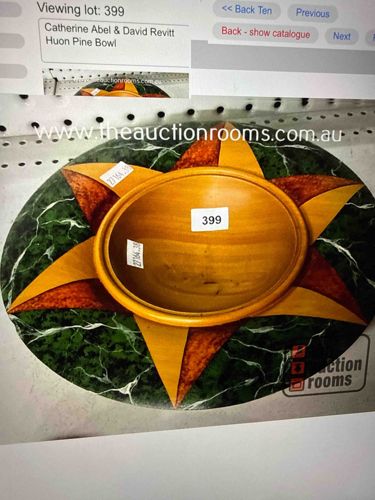
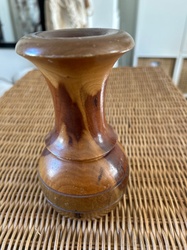
This exquisite piece appears to be a Huon Pine bowl, likely crafted by Catherine Abel & David Revitt, presented on what looks like a decorative inlaid base or platter. The central bowl is turned from Huon Pine, a highly prized Australian timber known for its fine grain, durability, and rich golden-yellow color, which is clearly visible here. The bowl has a smooth, well-polished surface suggesting quality craftsmanship, with a subtle rim detail. It exhibits a natural wood grain pattern, characteristic of Huon Pine, adding depth and organic beauty. The bowl sits within a larger, circular base that features an intricate inlay design. This base is predominantly dark emerald green, possibly a type of marble or a resin designed to mimic marble, with distinct white or lighter green veining throughout, giving it a luxurious and sophisticated appearance. Radiating outwards from the central bowl are star-like or sunburst patterns created by inlaid sections. These sections are made from two different materials: one is a lighter golden-yellow, possibly a different type of wood contrasting with the Huon pine, or a lighter stain of the same wood; the other is a reddish-brown material, perhaps a darker wood like mahogany orJarrah, or a composite material designed to create this warm tone. The construction appears to be high quality, with precise cuts and a seamless fit between the inlaid elements and the base material. The overall condition looks very good, with no immediately visible chips, cracks, or significant wear. The surfaces appear to be clean and well-maintained. The combination of the warm Huon Pine, the rich green veined material, and the contrasting inlaid woods suggests a piece of artistic and functional decor, possibly dating from the late 20th to early 21st century, given the contemporary aesthetic and use of an acclaimed timber like Huon Pine in artisan goods.', Item Category: 'Decorative Arts
AI Appraisal Report
I have thoroughly examined the provided images of this exquisite Huon Pine bowl on an inlaid base, attributed to Catherine Abel & David Revitt. Visually, the piece appears to be in very good to excellent condition; the Huon Pine bowl exhibits its characteristic warm golden hue and fine grain, with a smooth, polished surface free from visible scratches, cracks, or chips. The inlaid base, with its deep emerald green material and radiating sunburst patterns in contrasting woods, shows precise craftsmanship and no apparent imperfections. The seamless fit of the inlaid elements suggests high-quality construction.
Authenticity, based solely on visual inspection of images, is suggestive but not fully verifiable. The style and materials are consistent with the craftsmanship expected from artisans working with prized timbers like Huon Pine in decorative arts. However, without a physical examination, authentication markings (signatures, labels), or provenance documentation from Catherine Abel & David Revitt, I cannot definitively confirm its origin. In-person examination would allow for closer inspection of construction techniques, material verification (e.g., confirming the green material as marble or a high-quality resin, and identifying the inlaid woods), and the presence of any artist's marks. Provenance documentation, such as receipts or certificates of authenticity, would be crucial for full verification.
The market for artisanal woodcraft, particularly pieces utilizing rare and prized timbers like Huon Pine, remains stable. Demand is driven by collectors and interior decorators seeking unique, handcrafted items. Comparables for high-quality, artist-attributed wooden bowls and decorative platters often range, but pieces with intricate inlay work and rare materials tend to command higher prices. The perceived rarity of a specific collaboration or design from these artisans also adds to its appeal. The combination of functional artistry and aesthetic appeal contributes positively to its value.
Considering the excellent visual condition, the use of highly valued Huon Pine, the intricate and well-executed inlay work, and the attribution to respected artisans, I estimate the appraisal value for this piece, assuming authenticity, to be in the range of $600 to $900. This range accounts for the desirability of the materials and craftsmanship, while acknowledging the limitations of image-based authentication.