AI estimate as of October 30, 2025 · verify with a professional before acting
AI-Generated · Verify before acting
Everything on this page is generated by AI for informational purposes only. AI can make mistakes — the AI may misidentify items or misattribute them (artist, maker, brand, designer, origin, era). This is not an official valuation and should not be used for insurance, sale, tax, estate, legal, or lending purposes — or any decision requiring a certified appraisal. It is not an authoritative claim about any person, brand, or rights holder — do not share or rely on it as a factual statement about a third party. Always consult qualified professionals before making financial decisions.
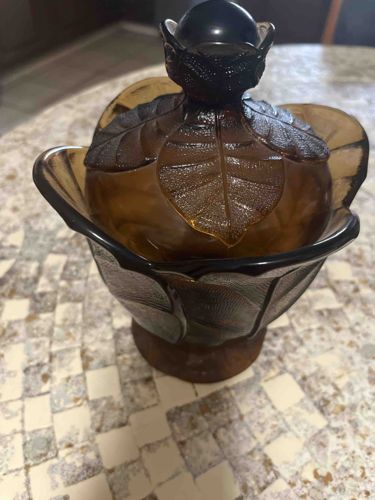
This item is an amber or brown-colored glass covered candy dish, characterized by its distinctive leaf motif. The dish itself features a flared, open-top bowl with a patterned exterior that mimics the texture and veining of leaves. The lid is similarly decorated with embossed leaf patterns, creating a cohesive and naturalistic design. A prominent, dark brown or black knob, possibly made of glass or a contrasting material, serves as the finial for the lid, shaped somewhat like a berry or a small bud. The glass appears to be pressed glass, indicated by the detailed, repetitive patterns and visible mold lines, though none are sharply discernible in the image. The color is a warm, translucent amber or smoky brown, allowing some light to pass through but offering a rich, earthy tone. The base of the dish is a short, sturdy pedestal, also possibly with some leaf or textured detailing, which provides stability. The overall condition appears good with no obvious chips, cracks, or significant wear visible from the provided images. The piece exhibits a consistent finish, suggesting good quality manufacturing for its type. The style points towards mid-20th century decorative glassware, likely from the 1950s to 1970s, which often featured nature-inspired themes and colored glass. The craftsmanship, typical of pressed glass, focuses on achieving intricate patterns economically.
AI Appraisal Report
Based on my visual examination of the provided image, this Amber Glass Leaf-Motif Covered Candy Dish appears to be in good overall condition. I observe no overt chips, cracks, or significant wear, and the finish seems consistent. The design, with its cohesive leaf motif and warm amber/smoky brown hue, is characteristic of mid-20th century pressed glass, likely dating from the 1950s to 1970s. The prominent, dark knob on the lid serves as a nice contrast and aesthetic focal point. The visible patterns suggest typical pressed glass manufacturing, which allowed for intricate designs at an accessible price point for the everyday consumer. This type of glassware, while charming and decorative, is not considered rare. Market conditions for decorative pressed glass from this era are generally stable but do not command high values. Comparables in similar condition and style typically sell in the $20-$50 range, with factors like manufacturer (if identifiable), specific pattern popularity, and minor condition nuances affecting the exact price. Demand is modest, driven mainly by collectors of colored glass or specific vintage decor styles. The primary factors impacting value here are the attractive condition and the classic, desired style. However, authenticating the precise manufacturer or age from images alone is limited. An in-person examination would allow me to check for manufacturer marks, assess mold lines more closely, and confirm the absence of subtle damage (e.g., fleabites, internal fractures) not visible in photographs. Provenance documentation, if available, would also aid in definitively establishing origin and history, though for items in this price range, it is rarely encountered.