AI estimate as of August 30, 2025 · verify with a professional before acting
AI-Generated · Verify before acting
Everything on this page is generated by AI for informational purposes only. AI can make mistakes — the AI may misidentify items or misattribute them (artist, maker, brand, designer, origin, era). This is not an official valuation and should not be used for insurance, sale, tax, estate, legal, or lending purposes — or any decision requiring a certified appraisal. It is not an authoritative claim about any person, brand, or rights holder — do not share or rely on it as a factual statement about a third party. Always consult qualified professionals before making financial decisions.
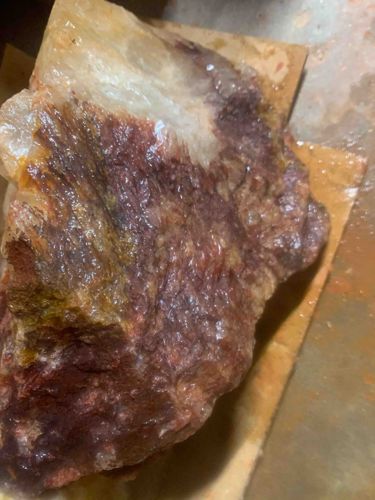
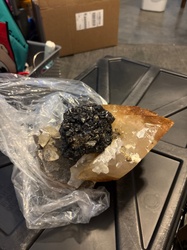
The item is a raw, unpolished mineral specimen, most likely a form of quartz with significant iron staining or inclusions, giving it a rich reddish-brown coloration. Its physical characteristics exhibit an irregular, amorphous shape, typical of naturally occurring mineral formations, suggesting it has not undergone significant cutting or shaping. The specimen is roughly palm-sized based on the visual context, but exact dimensions are not discernible. The material appears dense and crystalline in areas, particularly in the lighter, translucent sections which display a milky to somewhat clear quartz-like quality. The dominant color is a dark, earthy red and brown, with areas transitioning to lighter, almost clear or amber tones. The surface is uneven and rugged with visible fissures, crevices, and natural fracture points, indicating its raw, unworked state. There is a noticeable wet sheen across the surface, potentially from water or a substance applied to enhance its appearance, highlighting the mineral's texture and color variations. No apparent repairs, major damage, or manufacturing marks are visible, as this is a natural specimen. The age is geological, while its presentation as a specimen could be contemporary. The quality is indicative of a natural, untreated mineral. The reddish-brown coloration suggests the presence of iron oxides, which are common impurities in quartz, giving it characteristics of something similar to Red Quartz or Iron-Stained Quartz.
AI Appraisal Report
Based on my visual examination of the provided image, I assess this Raw Iron-Stained Quartz Specimen to be a natural and authentic mineral formation. Its irregular shape, visible fissures, and crystalline structure in various areas are consistent with unpolished, unworked quartz. The dominant reddish-brown coloration is highly suggestive of iron staining or inclusions, a common natural occurrence.
The condition appears excellent for a raw specimen; there are no signs of significant damage, repairs, or artificial enhancement beyond what appears to be a wetting to highlight features. The 'wet sheen' noted might temporarily enhance color and texture for photographic purposes, but doesn't alter the specimen's inherent quality.
In terms of market conditions, raw mineral specimens like this, while appealing for their natural beauty, typically fall into the enthusiast or decor market rather than high-end collector categories unless they exhibit exceptional size, clarity, unique formations, or extremely rare mineral associations. Comparables for such iron-stained quartz, considering its palm-sized indication and aesthetic, usually range from modest prices online and at mineral shows. Demand is steady among hobbyists and those seeking natural decor, but it's not a rare mineral type. Its value is primarily driven by its aesthetic appeal and size.
Factors impacting its value include its attractive coloration and natural form. However, its commonality, lack of significant crystal faces or rare inclusions, and relatively small size (though not precisely known without scaling) limit its upper valuation.
It is crucial to note the limitations of authenticity verification from images alone. While typical natural characteristics are present, an in-person examination would allow me to accurately gauge its exact dimensions, weight, true luster, and tactile properties. Provenance documentation, while not usually available for common raw specimens, could offer a chain of custody if it were a high-value or unusual piece. Scientific testing, such as X-ray diffraction, would definitively confirm mineral composition (quartz) and identify the iron compounds, but this is generally not cost-effective or necessary for specimens of this expected value. My assessment of its natural origin and the absence of artificial treatment is based purely on visual cues, which can occasionally be misleading without physical inspection.
Considering these factors, I appraise this Raw Iron-Stained Quartz Specimen within the range of $40 to $75.