AI estimate as of October 15, 2025 · verify with a professional before acting
AI-Generated · Verify before acting
Everything on this page is generated by AI for informational purposes only. AI can make mistakes — the AI may misidentify items or misattribute them (artist, maker, brand, designer, origin, era). This is not an official valuation and should not be used for insurance, sale, tax, estate, legal, or lending purposes — or any decision requiring a certified appraisal. It is not an authoritative claim about any person, brand, or rights holder — do not share or rely on it as a factual statement about a third party. Always consult qualified professionals before making financial decisions.
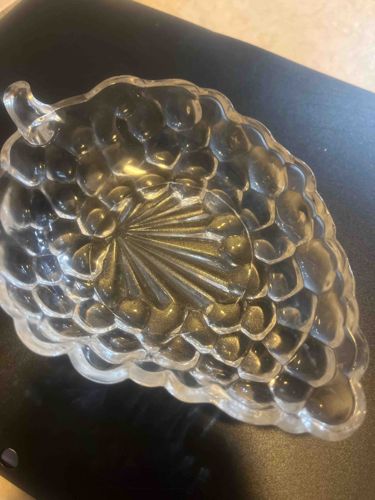
This item is a clear pressed glass dish, meticulously molded to resemble a cluster of grapes. Its physical characteristics include a translucent, colorless glass, with the overall shape forming an elongated oval, tapering at one end to simulate the stem of a grape cluster. The surface is textured with numerous raised, circular or slightly oval 'berries' of varying sizes, simulating individual grapes, which create a tactile and visually engaging effect. The edges of the dish generally follow the irregular contour of the grape cluster, adding to its organic feel. A notable feature is the fanned or ribbed design originating from the 'stem' end and extending into the central depression of the dish, possibly representing the stem attachment points or simply an decorative element to enhance the light refraction. The underside appears to be relatively flat to allow it to sit stably. The dish seems to be in good condition, with no overt chips, cracks, or significant visible wear, scratches, or repairs apparent from the image. The clarity of the glass suggests it has been well-maintained. There are no discernible maker's marks, signatures, or stamps visible from this angle. Given the style, it is likely a vintage piece, possibly from the mid to late 20th century, a period when pressed glass serving dishes with fruit or botanical motifs were popular. The craftsmanship is typical of mass-produced pressed glass, aiming for a decorative yet functional piece.
AI Appraisal Report
Based on my visual examination of the provided image, this clear pressed glass dish, molded to resemble a grape cluster, appears to be in excellent condition. There are no apparent chips, cracks, or significant wear, which is a positive factor for its value. The clarity of the glass suggests good care. This piece is consistent with mass-produced pressed glass prevalent from the mid to late 20th century. Authenticity as a vintage piece is highly likely, considering the manufacturing style; however, without a maker's mark, specific origin or age cannot be definitively confirmed from the image alone.
Market conditions for vintage pressed glass serving dishes of this type are generally modest. While decorative and functional, these items were produced in high volumes, meaning they are not rare. Comparables in the online marketplace and at estate sales typically fetch prices in the range of $10 to $40, depending on condition, specific design, and seller. There isn't significant demand for these common pressed glass pieces beyond general decorative or nostalgic appeal. Factors impacting value are primarily condition and aesthetic appeal; minor flaws would significantly reduce desirability and price.
Limitations in authenticity verification from images alone are notable. Without physical inspection, I cannot confirm the absence of minute scratches, internal flaws, specific glass composition, or evidence of repair that might not be visible in photographs. An in-person examination would allow for tactile inspection, detailed scrutiny under varying light, and the search for any faint mold lines or marks that could indicate a manufacturer. Provenance documentation, such as original sales receipts or family history, would be needed for definitive authentication of age or origin, but is rarely available for items of this nature.