AI estimate as of October 17, 2025 · verify with a professional before acting
AI-Generated · Verify before acting
Everything on this page is generated by AI for informational purposes only. AI can make mistakes — the AI may misidentify items or misattribute them (artist, maker, brand, designer, origin, era). This is not an official valuation and should not be used for insurance, sale, tax, estate, legal, or lending purposes — or any decision requiring a certified appraisal. It is not an authoritative claim about any person, brand, or rights holder — do not share or rely on it as a factual statement about a third party. Always consult qualified professionals before making financial decisions.
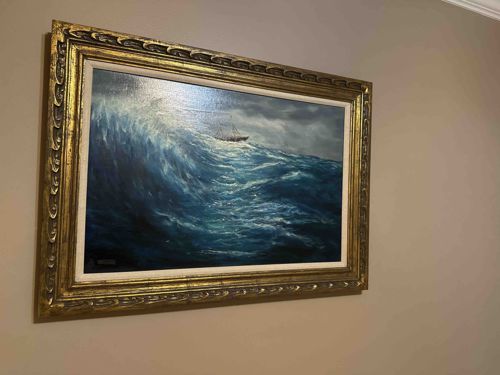
This item is an oil painting depicting a dramatic seascape scene, featuring a sailing ship battling immense waves during a storm. The primary colors used are deep blues and greens for the turbulent water, contrasted with white crests of the waves, and a somber grey for the sky. The ship, rendered in dark tones, appears small and vulnerable against the towering swell, emphasizing the power of nature. Physical characteristics of the painting itself are difficult to ascertain fully without dimensions, but it appears to be a medium to large-sized canvas, presented in a substantial, ornate gilded frame. The frame features a rich, antique gold finish with pronounced scrolling and foliate relief details along its inner and outer edges, suggesting a traditional or classical aesthetic. The inner edge of the frame has a white or off-white liner, which serves to visually separate the painting from the ornate frame and provides a subtle transition. The brushwork in the painting appears expressive and textured, particularly in the rendering of the waves, suggesting impasto techniques to convey the movement and frothy nature of the water. Visible condition issues are minimal from the provided image; the frame shows a consistent patina associated with age, and the painting itself appears to be in good condition, with no obvious signs of significant damage, discoloration, or cracking. While no specific artist's signature or manufacturing mark is clearly visible in the provided images, the style suggests a 20th-century marine art piece, possibly influenced by romantic or realist traditions. The quality indicators point to a well-executed work, both in the painting's composition and the choice of a complementary, decorative frame, indicating a piece intended for display as a significant装饰 element. The overall impression is one of a classical and dramatic marine art piece.
AI Appraisal Report
Upon visual examination of the provided images, this seascape oil painting presents as a competent and dramatic work in the tradition of 20th-century marine art. The piece depicts a classic 'ship in a storm' motif, executed with expressive brushwork, particularly in the impasto rendering of the turbulent waves. The painting appears to be in good condition, with no visible cracking, flaking, or significant discoloration. It is housed in a substantial, ornate gilded frame that complements the work, although the frame itself shows a typical patina and minor age-related wear. The primary limiting factor in this appraisal is the anonymity of the artist. Without a visible signature or any accompanying provenance, the work must be valued as a decorative piece by an unaccredited or 'journeyman' painter. The market for unsigned, traditional seascapes is stable but generally modest. Similar works of this size and quality by unknown artists typically achieve values between $600 and $900 in a competitive auction setting. The value is supported by its strong decorative appeal rather than any established artist's reputation. To confirm authenticity and potentially increase value, an in-person examination is critical. This would involve searching for a hidden or obscured signature, examining the canvas, stretchers, and frame for age indicators or maker's marks, and using UV light to check for restorations or overpainting. Full authentication would require establishing provenance through documentation (receipts, gallery history) or scholarly attribution.