AI estimate as of August 13, 2025 · verify with a professional before acting
AI-Generated · Verify before acting
Everything on this page is generated by AI for informational purposes only. AI can make mistakes — the AI may misidentify items or misattribute them (artist, maker, brand, designer, origin, era). This is not an official valuation and should not be used for insurance, sale, tax, estate, legal, or lending purposes — or any decision requiring a certified appraisal. It is not an authoritative claim about any person, brand, or rights holder — do not share or rely on it as a factual statement about a third party. Always consult qualified professionals before making financial decisions.
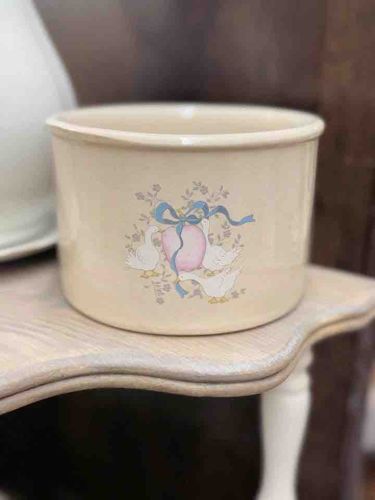
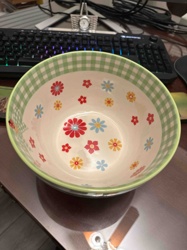
This item is a cylindrical ceramic planter or storage crock, featuring a cream or light beige glazed finish. Its dimensions appear to be approximately 6-8 inches in diameter and similar in height, suggesting it's a medium-sized vessel. The most notable feature is the decorative motif on its side, which depicts a pastoral or nursery theme. Central to the design is a large, pink egg, possibly an Easter egg, adorned with a blue ribbon tied into a bow. Surrounding the egg are three white geese or ducks, rendered with visible wing feathers and simple, solid-colored bodies. The animals are positioned amongst delicate floral and leafy sprigs in muted tones of purple, green, and perhaps light blue. The overall aesthetic suggests a charming, somewhat nostalgic style, common in decorative ceramics from the late 20th century, likely 1980s or 1990s. The gloss of the glaze indicates it's ceramic, possibly stoneware or earthenware. The rim appears to be smoothly finished, and there are no immediately visible chips, cracks, or significant wear, suggesting it is in good condition. The craftsmanship appears to be standard for mass-produced decorative ceramic items, with the decal or painted design applied evenly. No specific maker's marks or signatures are discernible from the provided images, but such items often have marks on the base.
AI Appraisal Report
I have examined the image of this cream ceramic planter with a goose and Easter egg motif. Visually, the piece appears to be in very good condition, with a glossy finish, and no discernible chips, cracks, or significant wear. The design, featuring geese, a large pink egg with a blue ribbon, and floral sprigs, is consistent with decorative ceramic homeware produced in the late 20th century, likely the 1980s or early 1990s. The charm is in its nostalgic aesthetic, typical of mass-produced items from that period.
From a market perspective, comparable items of this type, often used for storage or as planters, generally fall into the affordable decorative homeware category. While appealing for its thematic design, particularly around Easter, these items are not considered rare. The demand is niche, primarily from collectors of vintage kitchenalia or decorative ceramics, but not high enough to command significant prices. The lack of a discernible maker's mark limits its value, as branded pieces, even from mass producers like Pfaltzgraff or துறை, sometimes fetch slightly more.
Factors impacting value include its good condition and endearing motif. However, its mass-produced nature and the general abundance of similar vintage decorative ceramics on the market keep the value modest. Authenticity, in terms of age and origin, is difficult to verify solely from images; in-person examination would be required to check for maker's marks on the base, assess the ceramic body more closely, and confirm the method of decoration (decal vs. hand-painted). Provenance documentation would further solidify its history, though it's unlikely to exist for such an item. Scientific testing, such as thermoluminescence dating, would be overkill and impractical for a piece of this nature and value.
Considering these factors, I assess its secondary market value primarily as a decorative accent piece.