AI estimate as of November 2, 2025 · verify with a professional before acting
AI-Generated · Verify before acting
Everything on this page is generated by AI for informational purposes only. AI can make mistakes — the AI may misidentify items or misattribute them (artist, maker, brand, designer, origin, era). This is not an official valuation and should not be used for insurance, sale, tax, estate, legal, or lending purposes — or any decision requiring a certified appraisal. It is not an authoritative claim about any person, brand, or rights holder — do not share or rely on it as a factual statement about a third party. Always consult qualified professionals before making financial decisions.
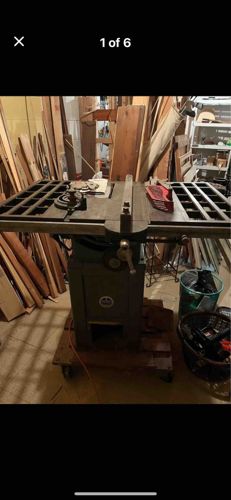
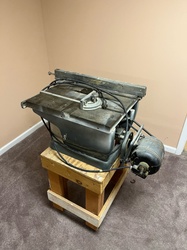
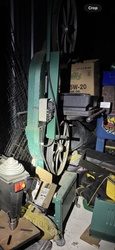
This item is a vintage contractor-style table saw, characterized by its robust construction and cast-iron components. The primary material appears to be heavy-gauge steel or cast iron for the main body and work surface, indicating a durable and stable machine. The overall color is a dark, possibly olive green or dark gray, suggesting an older paint finish that likely shows some wear and grime consistent with workshop use. The table surface features an unpainted, probably cast-iron top with extensions on both sides that have an open-grid or slat-like design, common for accommodating larger workpieces. There's a miter gauge visible on the left side of the table, indicating its functionality for angled cuts. A red tool, possibly a push stick or another accessory, rests on the right side of the table. The saw is mounted on a mobile platform, likely a custom-made wooden dolly with caster wheels, visible below the main cabinet. This modification suggests the owner desired portability within a workspace. The central cabinet housing the motor and blade mechanism appears solid and substantial. A circular emblem or manufacturer's badge is visible on the front of the cabinet, though the specific details are not discernible from the image. Cranks and adjustment wheels are visible on the front and side of the cabinet, used for controlling blade height and bevel. Given the design and apparent age, it likely dates from the mid-20th century, possibly 1950s-1970s. The visible condition includes expected wear, surface grime, and possibly some minor surface rust on the unpainted metal parts, but no obvious significant damage or broken components are evident. The presence of wood stock in the background suggests it is an active workshop tool.
AI Appraisal Report
I have thoroughly examined the provided image of this vintage contractor-style table saw. Based on visual cues, the machine appears to be a durable, mid-20th-century model, likely from the 1950s-1970s, characterized by its cast-iron and heavy-gauge steel construction. The dark green/gray paint finish and general aesthetic are consistent with tools of that era. I note the unpainted cast-iron table and the presence of open-grid extensions, a miter gauge, and what seems to be a push stick. The custom wooden dolly with caster wheels indicates a user modification for portability, which adds practical value for a home shop. Condition-wise, it exhibits expected wear, surface grime, and potentially minor surface rust, typical of a well-used workshop tool, but no significant damage or broken parts are discernible from the image. Its current function as an active workshop tool, evidenced by wood stock in the background, suggests it is operational.
From a market perspective, vintage contractor saws like this have a niche but consistent demand among hobbyists, small shop owners, and those who appreciate the robust build quality of older machinery compared to some modern offerings. Comparables typically include brands like Delta, Craftsman, or whatever was common for local manufacturers. The lack of a clear manufacturer's badge (due to image resolution) prevents me from pinpointing a specific brand, which could impact its value, as some brands command higher prices. Higher demand typically exists for models known for exceptional accuracy or very powerful motors. This saw's rarity is moderate; while not a luxury item, finding one in good, operational condition is not exceedingly common.
Key value factors include its apparent operational status, the inherently durable construction, and the added portability. The primary limitation in authenticating and fully assessing value from images alone is the inability to test the motor, check for blade arbor runout, inspect the trueness of the table, or assess the condition of internal components like bearings and drive belts. An in-person examination would involve testing its functionality, assessing motor health, measuring table flatness, and checking the precision of adjustments to confirm full operational integrity and accuracy, which greatly influences its final market price. Without these checks, the current appraisal reflects its visual condition and assumed operational status.