AI estimate as of October 12, 2025 · verify with a professional before acting
AI-Generated · Verify before acting
Everything on this page is generated by AI for informational purposes only. AI can make mistakes — the AI may misidentify items or misattribute them (artist, maker, brand, designer, origin, era). This is not an official valuation and should not be used for insurance, sale, tax, estate, legal, or lending purposes — or any decision requiring a certified appraisal. It is not an authoritative claim about any person, brand, or rights holder — do not share or rely on it as a factual statement about a third party. Always consult qualified professionals before making financial decisions.
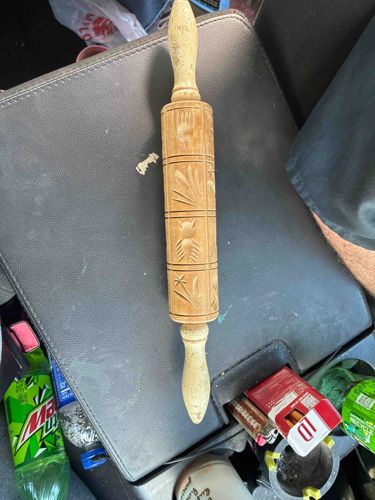
This is a carved wooden rolling pin, likely used for baking, particularly for doughs that benefit from textured surfaces, like springerle cookies or decorative pastry. The rolling pin is constructed from light-colored wood, possibly beech or birch, which has developed a warm, aged patina over time, suggesting considerable use or age. It features a central cylindrical barrel with two integrated, tapered handles on either end. The handles are smooth, indicating repeated gripping, and show a slightly lighter color than the barrel, perhaps due to less direct contact with flour or other baking ingredients, or a different finishing process. The most distinctive feature is the intricate carving on the barrel, divided into multiple horizontal bands. Each band appears to feature a repeating a decorative motif, including what looks like stylized floral or wheat stalk patterns and possibly animal figures, such as owls. The carvings are relatively deep, suggesting they would effectively transfer a pattern onto dough. The overall condition shows signs of wear consistent with age and use, including some minor surface abrasions or discoloration visible on the wood. There are no obvious cracks or structural damages that would impede its function, though a closer inspection would be needed to confirm the absence of subtle splits. The craftsmanship appears to be folk art in style, characteristic of handmade kitchen implements from the mid-20th century or earlier, emphasizing functionality with an artistic flair. It is a single piece construction where the handles are integral to the barrel, not separate rotating components, suggesting a traditional design.
AI Appraisal Report
Based on my visual examination of the image, this carved wooden rolling pin appears to be an authentic vintage kitchen implement. The light-colored wood, likely beech or birch, shows a warm, aged patina consistent with an item from the mid-20th century or earlier. The integrated, tapered handles and single-piece construction are characteristic of traditional, possibly folk art, design. While the carvings are intricate and suggest effective pattern transfer, their specific motifs (stylized floral/wheat stalk, owls) point to a decorative and functional piece. The condition, showing signs of wear and minor surface abrasions, is consistent with age and use without overt damage. I observe no cracks or structural issues from the image, suggesting good functional integrity.
Market conditions for such items vary, but high-quality carved wooden rolling pins with specific motifs, particularly for springerle or decorative baking, are collected. Comparables often range from $50 for simpler designs to $150+ for highly detailed or particularly old examples. Demand for decorative kitchenalia and specific baking tools is steady among collectors and historical reenactors. The rarity of this particular pattern is difficult to ascertain from an image alone, but its aesthetic appeal contributes positively to its value.
Factors impacting value include the intricate carving detail, apparent good structural condition, and the warm patina indicative of age. However, a significant limitation in full authenticity verification is the reliance solely on images. An in-person examination would be crucial to confirm the absence of subtle splits or repairs, assess the depth and crispness of the carvings, and verify the wood type. Provenance documentation would confirm its age and origin, while scientific testing could precisely date the wood. Without these, the appraisal provides a strong estimate based on visual cues and market dynamics.