AI estimate as of October 28, 2025 · verify with a professional before acting
AI-Generated · Verify before acting
Everything on this page is generated by AI for informational purposes only. AI can make mistakes — the AI may misidentify items or misattribute them (artist, maker, brand, designer, origin, era). This is not an official valuation and should not be used for insurance, sale, tax, estate, legal, or lending purposes — or any decision requiring a certified appraisal. It is not an authoritative claim about any person, brand, or rights holder — do not share or rely on it as a factual statement about a third party. Always consult qualified professionals before making financial decisions.
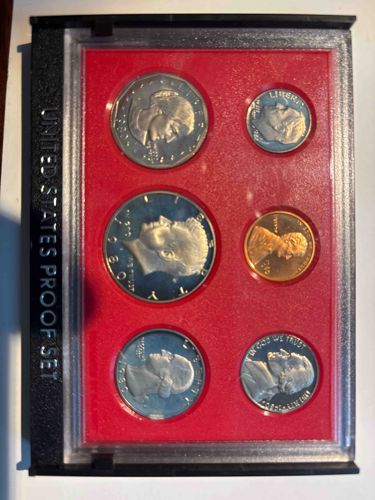
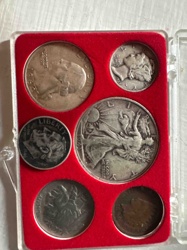
This item is a United States Proof Set, likely from the late 20th century given the style of presentation and the appearance of the coins. The set is encased in its original black plastic holder, which has 'UNITED STATES PROOF SET' embossed vertically along the left edge. The coins are securely embedded in a vibrant red felt or velvet-like insert, protected by a clear plastic cover. The set contains six coins, arranged in two columns. From top to bottom, the left column features a larger coin, likely an Eisenhower Dollar, and a Kennedy Half Dollar. The right column contains a Roosevelt Dime, a Lincoln Cent (copper-toned), a Washington Quarter, and a Jefferson Nickel. All coins exhibit a 'proof' finish, characterized by their highly polished, mirror-like fields and frosted, sculpted devices (the raised elements of the design). This contrast creates a striking visual effect, indicating a higher quality strike than business strike coinage. The coins appear to be in excellent, uncirculated condition, showing no visible wear, scratches, or toning that would detract from their original luster. The clear plastic cover, while doing its job of protection, may have minor surface scuffs typical of handling over time, though none are significantly visible in the provided image. The overall presentation suggests a collectible item, valued for its pristine condition and the specialized proof minting process. The precise year of the set is not discernible from the images, but the denominations and designs confirm it as a standard US proof set from a specific year. No specific maker's marks or signatures are visible beyond the standard minting details on the coins themselves.
AI Appraisal Report
Based on my visual examination of the provided image, this United States Proof Set appears to be in excellent, uncirculated condition, consistent with a proof set stored in its original government packaging. The coins exhibit the characteristic mirror-like fields and frosted devices indicative of the proof minting process. I see no visible signs of wear, scratches, or significant toning on the coins themselves, suggesting a well-preserved example. The original black plastic holder and red velvet insert are intact, enhancing its presentation as a collectible. The presence of an Eisenhower Dollar and Kennedy Half Dollar, along with the standard quarter, dime, nickel, and cent, confirms it as a typical US Proof Set from the late 20th century.
However, the precise year of the set is a crucial factor in determining its value, and this cannot be ascertained from the image alone. US Proof Sets were minted annually, and while most common dates from the 1970s, 80s, and 90s generally trade for a modest premium over face value or around their original issue price, certain years (e.g., 1976 Bicentennial, 1999 with the first state quarters) can sometimes command slightly higher prices due to design or mintage variations.
Demand for common-date modern proof sets is generally stable but not exceptionally strong, with a large supply readily available on the secondary market. Rarity is low for most modern proof sets. Significant factors impacting value would be the specific year (undeterminable here), any highly sought-after varieties (unlikely but possible), and the complete absence of any imperfections upon closer physical inspection.
Limitations: Without being able to physically inspect the set, I cannot definitively verify the authenticity of each coin for potential alterations or confirm the precise condition of the plastic case (e.g., hazing, cracks, significant scuffs) or the coins themselves for subtle toning or hairline scratches that may not be apparent in a photograph. Full authentication would require in-hand examination to confirm the mint marks, the absence of any post-mint damage, and the exact year of issue.