AI estimate as of December 11, 2025 · verify with a professional before acting
AI-Generated · Verify before acting
Everything on this page is generated by AI for informational purposes only. AI can make mistakes — the AI may misidentify items or misattribute them (artist, maker, brand, designer, origin, era). This is not an official valuation and should not be used for insurance, sale, tax, estate, legal, or lending purposes — or any decision requiring a certified appraisal. It is not an authoritative claim about any person, brand, or rights holder — do not share or rely on it as a factual statement about a third party. Always consult qualified professionals before making financial decisions.
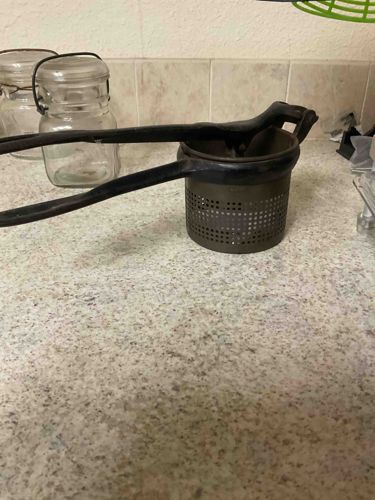
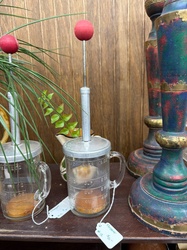
This item is a vintage hand-crank food mill or ricer, likely constructed from a dark-colored, possibly cast iron or blackened steel, metal for the main body and handles, with a perforated basket made of a lighter, perhaps tin or aluminum, metal. The overarching color is a dark, almost charcoal gray or black, with some areas showing a slightly lighter metallic sheen where wear has occurred. The food mill consists of a cylindrical basket with numerous small, square-shaped perforations uniformly distributed around its sides and bottom, designed for pureeing or ricing soft foods. A long handle extends from one side of the basket, providing leverage for the user to hold the device. Opposite this handle, a shorter, curved handle is visible, likely connected to a rotating blade or pressing mechanism inside the basket. This interior mechanism is not clearly visible but is suggested by the operating design of such mills. The item exhibits clear signs of age and use, including scuffs, scratches, and a prominent patina consistent with an older kitchen utensil. There are no immediate signs of significant damage like cracks or major deformities, but general surface wear and some rust spotting might be present, which would be typical for an older utilitarian metal item. No visible manufacturer's marks or signatures are discernable from the provided image. The design suggests a mid-20th-century style, characteristic of robust, functional kitchen tools built for durability. The craftsmanship appears sturdy and straightforward, focusing on utility rather than elaborate aesthetic details. The construction method appears to involve riveted or welded connections for the handles to the main body.
AI Appraisal Report
Upon visual examination of the Vintage Hand-Crank Food Mill/Ricer, I assess its condition as good vintage, consistent with age and regular use. The overall dark metal construction, likely cast iron or blackened steel, paired with a lighter perforated basket (tin or aluminum), shows expected wear including scuffs, scratches, and a pervasive patina. There are no obvious signs of significant structural damage such as large cracks or major deformities. However, the presence of rust spotting would be typical and needs to be factored in, though its extent cannot be fully determined from images alone.
Authenticity appears solid as a genuine vintage kitchen utensil, given the design and evident wear. The lack of manufacturer's marks is common for utilitarian items of this era. An in-person examination would allow for a tactile assessment of material, better identification of rust severity, and a more thorough check for any hidden repairs or damage. Provenance documentation would be ideal to confirm age and origin, but is rarely available for such common household items.
Market conditions for vintage hand-crank food mills are generally stable, driven by collectors of antique kitchenware, home cooks preferring traditional methods, and those seeking rustic decor. These items are not particularly rare; many were produced across the mid-20th century. Comparables on online marketplaces and at antique shops typically range from $15 to $50, depending on condition, brand (if identifiable), and completeness. This specific item, lacking clear branding and with visible signs of wear, falls into the lower to mid-range of this spectrum. Demand is moderate, limited to niche interests rather than broad appeal. Factors impacting value negatively include the absence of clear branding, typical wear and tear, and the lack of a visible rotating mechanism. The sturdy construction and functional appearance are positive points. The absence of specific identifying marks prevents attribution to a higher-end manufacturer, which would increase value. Without physical inspection, I cannot confirm the exact metal composition or the full functionality of the internal mechanism, which could slightly alter my assessment.