AI estimate as of September 25, 2025 · verify with a professional before acting
AI-Generated · Verify before acting
Everything on this page is generated by AI for informational purposes only. AI can make mistakes — the AI may misidentify items or misattribute them (artist, maker, brand, designer, origin, era). This is not an official valuation and should not be used for insurance, sale, tax, estate, legal, or lending purposes — or any decision requiring a certified appraisal. It is not an authoritative claim about any person, brand, or rights holder — do not share or rely on it as a factual statement about a third party. Always consult qualified professionals before making financial decisions.
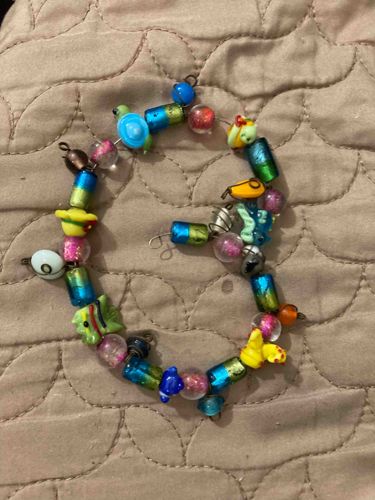
This item is an assorted beaded charm bracelet, appearing to be crafted from various types of glass and possibly acrylic beads, with metal findings. The beads are arranged in a generally circular shape, suggesting it is a completed or nearly completed bracelet. The color palette is vibrant and varied, featuring shades of blue, green, pink, yellow, red, orange, and clear. A notable characteristic is the inclusion of several shaped 'charm' beads, such as a light blue turtle, a yellow fish with red accents, a striped fish, a yellow butterfly, a blue blob-like shape, and potentially other animal or whimsical forms. Many of the cylindrical or round beads exhibit a shimmering or iridescent quality, possibly lampwork glass or a foiled inner core. Some clear spherical beads contain glitter, primarily pink. The metal components, likely base metal, consist of small eye pins and jump rings connecting the beads, which are visible as loops protruding from each individual bead. The construction appears to be a series of individual beads strung onto headpins or eyepins and then linked together. The visible condition suggests some wear, with minor oxidation or dullness on some metal findings and a general accumulation of dust or debris in crevices, particularly around the connections. There are no obvious signs of significant damage like breaks or chips, but closer inspection would be required to confirm. The style suggests a playful, informal aesthetic, likely dating from the late 20th to early 21st century, possibly handmade or mass-produced craft jewelry. The craftsmanship, while not high-end, appears consistent for costume jewelry of this type, with all beads securely attached.
AI Appraisal Report
I have visually examined the Assorted Beaded Charm Bracelet. My assessment indicates a condition consistent with light to moderate wear for costume jewelry. The metal findings show minor oxidation and dullness, and some dust/debris is present in crevices. However, there are no visible chips, cracks, or missing components. Authenticity is difficult to ascertain purely from images; this appears to be a mass-produced or a handmade craft item rather than fine jewelry. The materials seem to be primarily various types of glass (potentially lampwork for iridescent/shimmering beads) and acrylic, linked with base metal components.
Market conditions for this type of whimsical, costume beaded bracelet are generally modest. Comparable items, often found in craft markets, online platforms like Etsy, or mass-market retailers, typically sell in the lower price ranges. There is no significant rarity associated with this style or materials; such bracelets are commonly available. The demand is likely driven by personal aesthetic preference rather than collectible value. Factors impacting value negatively include the use of base metals, common bead materials, and the craft-level construction. It lacks hallmarks, precious materials, or artisan signatures that would elevate its value.
Limitations in authenticity verification are significant. Without a physical examination, I cannot definitively confirm bead material (e.g., distinguishing between true lampwork glass and coated acrylic), the exact metal composition of findings, or assess the integrity of all connections. In-person inspection would allow for tactile assessment of bead quality, specific gravity tests for material verification, and closer examination of manufacturing consistency. Provenance documentation would be needed to affirm any claims of artisan origin. Scientific testing for material analysis is not warranted given the likely value.