AI estimate as of December 8, 2025 · verify with a professional before acting
AI-Generated · Verify before acting
Everything on this page is generated by AI for informational purposes only. AI can make mistakes — the AI may misidentify items or misattribute them (artist, maker, brand, designer, origin, era). This is not an official valuation and should not be used for insurance, sale, tax, estate, legal, or lending purposes — or any decision requiring a certified appraisal. It is not an authoritative claim about any person, brand, or rights holder — do not share or rely on it as a factual statement about a third party. Always consult qualified professionals before making financial decisions.
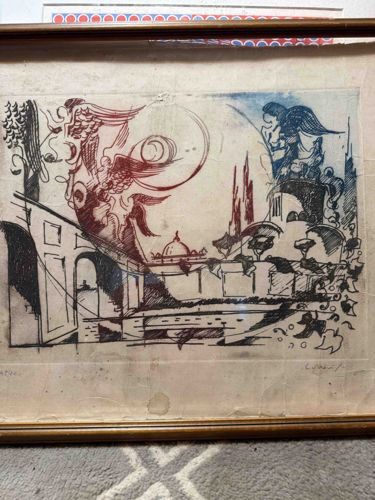
The item is a framed, limited edition etching print, characterized by its monochromatic black lines accented with selective red and blue coloration. The print depicts a whimsical, architectural landscape combined with fantastical elements. On the left, stylized angelic or winged figures, rendered in red, swirl dynamically amidst what appears to be musical notes or abstract ornamentation. These figures are contrasted with an architectural structure featuring arches and walls, executed in black lines. In the center, a large circular motif suggests a moon or celestial body, around which red-inked spires or structures rise, creating depth and a sense of a distant city. To the right, another winged figure, partially visible and colored in blue, sits atop what seems to be architectural ruins or a monument, also defined by black lines. The overall scene blends classical architectural influences with surreal or fantastical elements. The print is housed under glass within a simple, light-colored wooden frame, likely pine or a similar wood, which has a smooth finish. The paper itself appears to be a light cream or off-white, showing signs of age and wear. Notable condition issues include distinct yellow-brown staining, particularly visible at the bottom left and central bottom sections, indicating moisture exposure or age-related discoloration. Small creases or waves in the paper are also observable, suggesting it may not be perfectly flat against the backing. The signature, 'C. W.' followed by illegible characters (possibly '1-3' or 'i-s'), is present in the bottom right corner, handwritten in pencil, typical for artist's proof or limited edition prints. Another smaller, possibly numerical marking, is in the lower-left corner, which could denote the edition number or a specific identifier. The style suggests a 20th-century aesthetic, possibly mid to late 20th century, with an emphasis on expressive line work and dramatic composition. The craftsmanship indicates a hand-pulled printing process, highlighting the artist's direct involvement in its creation.
AI Appraisal Report
Based on my visual examination of the provided image, I assess this framed, limited edition etching print. The artwork, with its monochromatic linework and selective red and blue accents, presents a compelling fantastical architectural landscape. The handwritten signature 'C. W.' and additional numerical marking are consistent with an artist-signed limited edition print, providing a good indication of authenticity within the artistic practice. The style suggests a mid to late 20th-century aesthetic.
However, the print's condition significantly impacts its value. The prominent yellow-brown staining at the bottom, likely due to moisture exposure, and the visible creasing/waving of the paper are notable detriments. While the simple wooden frame is adequate for display, it is not of high collector quality.
In terms of market conditions, while hand-pulled etchings generally hold a niche market, the discernible condition issues will deter serious collectors, limiting its appeal primarily to decorative buyers or enthusiasts of whimsical art. Without a known artist with established auction records, comparables are difficult to pinpoint precisely, but similar unsigned or unknown artist works in this condition typically fall into a lower price bracket. Demand for unidentifiable artists is inherently lower.
For full authentication and a more precise valuation, an in-person examination is crucial. This would allow me to physically inspect the paper quality, printing technique, and true extent of the damage, which can appear differently in person than in photographs. Additionally, provenance documentation (e.g., purchase receipts, artist's certificates) and expert analysis of the signature to confirm the artist's identity would be vital to verify authenticity and assess rarity accurately. Without the artist's full name, the 'limited edition' aspect has less market impact.