AI Appraisal Estimate

AI-generated estimates · not official valuations

From the user

What was submitted

Photo and notes provided by the user — not generated by AI

Submitted item photo
Submitted photo · June 25, 2026

User's notes

Klaus Meyer-Gasters

AI analysis below

AI appraisal

AI analysis & estimate

AI-Generated · Verify before acting

Everything below is generated by AI for informational purposes only. AI can make mistakes — the AI may misidentify items or misattribute them (artist, maker, brand, designer, origin, era). This is not an official valuation and should not be used for insurance, sale, tax, estate, legal, or lending purposes — or any decision requiring a certified appraisal. It is not an authoritative claim about any person, brand, or rights holder — do not share or rely on it as a factual statement about a third party. Always consult qualified professionals before making financial decisions.

Note

This analysis also relies on unverified notes provided by the user, which may be incomplete or inaccurate and could affect the result.

Read the full disclaimer

AI Identification

·Not independently authenticated·Verify before acting

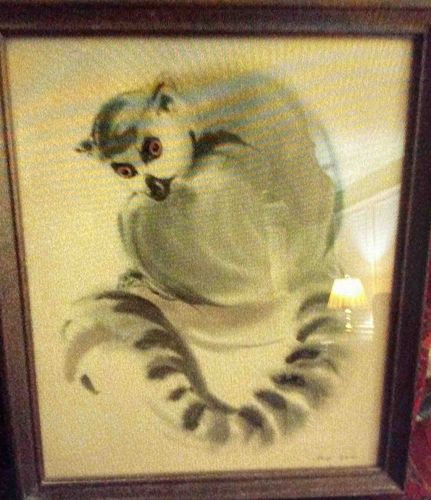
Ring-tailed Lemur (Katta) Art Print by Klaus Meyer-Gasters

Fine Art - Prints & Illustrated Paintings

AI Estimated Value

·Not an official valuation·Verify before acting

$150 - $300

As of June 25, 2026

AI Item Analysis

·AI can make mistakes·Verify before acting
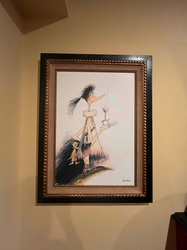
This is a framed art piece, appearing to be a high-quality lithograph or print of a watercolor painting depicting a ring-tailed lemur (Lemur catta). The artwork is the characteristic style of German painter Klaus Meyer-Gasters (1925-2016), known for his animalier subjects and expressive use of wet-on-wet technique. The lemur is rendered with soft, blurred edges and a muted color palette of cool greys, greens, and blacks, contrasted by distinct orange-red eyes and a long, banded tail that curls toward the foreground. The composition is set against a simple, light-toned background. The piece is housed in a dark wood frame with visible grain, likely stained oak or mahogany, and protected under a sheet of glass which shows significant reflection. There is a signature visible in the lower right corner appearing to read 'Meyer-Gasters'. The condition shows some slight yellowing of the paper consistent with age (mid-to-late 20th century) and minor surface wear to the frame. The print quality suggests a mid-century botanical/zoological illustration style, emphasizing both scientific accuracy and artistic fluidity.
AI Appraisal Report

·AI can make mistakes·Verify before acting
Based on my visual examination of the framed lithograph, I have identified this as a characteristic work by Klaus Meyer-Gasters (1925-2016). The piece exhibits his signature technical mastery of the wet-on-wet watercolor style, translated into a high-quality print. The subject—a ring-tailed lemur—is a desirable example of Meyer-Gasters' animalier genre, which remains popular among collectors of mid-century European biological illustrations. The condition of the work is fair to good. I observe visible toning (yellowing) of the paper substrate, which is typical for mid-to-late 20th-century prints but does suggest long-term exposure to light or acidic mounting materials. The dark wood frame shows minor scuffing coherent with age, though it remains structurally sound. The market for Meyer-Gasters prints is stable but modest; while his original watercolors fetch significantly higher premiums, these commercial lithographs were produced in relatively large quantities, which limits their rarity. Factors impacting value include the presence of the signature and the quality of the framing. However, the value is tempered by the lack of a limited edition number (it appears to be an open-edition offset lithograph) and the aforementioned paper oxidation. Limitations to this appraisal: Authenticity is based on visual style and signature analysis from a digital image. A definitive valuation would require an in-person inspection to verify the paper's watermark, determine if the signature is hand-signed or printed, and examine the reverse for publisher marks or provenance labels. For absolute authentication, removal from the frame would be necessary to check for hidden damage or acidity.

Get your items appraised

Instant estimates of your treasures with AI-powered appraisals

Browse More Appraisals