These notes were written by the person who submitted this item. Appraiser.AI has not verified them, and the AI's identification and estimate may rely on them.
AI Estimated Value
Not an official valuation
$600-900
AI estimate as of July 12, 2025 · verify with a professional before acting
AI-Generated · Verify before acting
Everything on this page is generated by AI for informational purposes only. AI can make mistakes — the AI may misidentify items or misattribute them (artist, maker, brand, designer, origin, era). This is not an official valuation and should not be used for insurance, sale, tax, estate, legal, or lending purposes — or any decision requiring a certified appraisal. It is not an authoritative claim about any person, brand, or rights holder — do not share or rely on it as a factual statement about a third party. Always consult qualified professionals before making financial decisions.
This analysis also relies on unverified notes provided by the user, which may be incomplete or inaccurate and could affect the result.
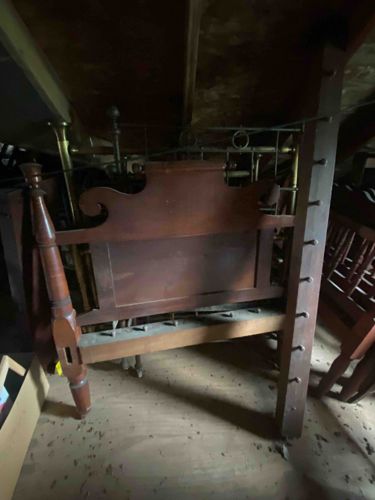
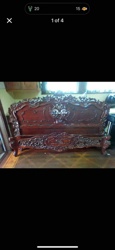
This appears to be a vintage or antique wooden rope bed, specifically featuring a headboard and possibly a footboard (partially obscured). The primary material is dark stained wood, likely a hardwood such as mahogany or cherry, given its rich, reddish-brown hue and the common materials used for beds of this style. The headboard is the most prominent feature, characterized by a central panel within a frame, topped with a distinctive, carved scroll or volute on the left side, suggesting a classical or Empire-style influence. The posts are turned, with the visible left post showing a substantial, ornate design tapering towards the top. Below the headboard panel, the bed frame elements are visible, including wooden rails with pegs or dowels protruding inwards. These pegs are characteristic of a rope bed, where ropes would crisscross to support a mattress, indicating an older construction method pre-dating modern bedsprings. The condition appears consistent with age, showing a natural patina, some dust, and potentially minor surface wear or scratches from use and storage. There are no immediate signs of major structural damage, though the full extent of the frame is not visible. The craftsmanship appears sturdy, with mortise and tenon or similar joinery probable given the era. The presence of brass elements in the background suggests a possible brass-and-wood combination, or another piece of furniture overlapping. The visible components strongly suggest an estimated age from the 19th or early 20th century.
AI Appraisal Report
Based on my virtual examination of the provided image and the owner's details, this antique wooden rope bed, featuring a prominent headboard, appears to be a genuine piece from the 19th or early 20th century. Its dark, rich wood and distinctive carved scroll on the headboard suggest a classical or Empire style, consistent with the construction methods of the era. The visible turned posts and, most importantly, the wooden rails with inward-protruding pegs, are definitive indicators of a rope bed, predating modern spring mattresses. This method of construction confirms its authenticity as an antique bed.
The condition appears good for its age, showing a natural patina and the expected minor surface wear. I observe no obvious structural damage from the image, though a complete physical inspection would be necessary to confirm stability and assess any hidden issues like woodworm or joinery looseness.
In terms of market conditions, antique rope beds have a niche but steady demand among collectors of period furniture or those seeking unique, historically significant pieces. While not as universally sought after as some other antique furniture categories, their unique construction and historical relevance can appeal to certain buyers. Comparables would include other 19th-century American or European antique beds, though the 'rope bed' feature sets this apart. Rarity is moderate – while not exceedingly rare, a well-preserved example with identifiable style elements like this is less common than typical mass-produced furniture.
Factors impacting value include its age, apparent good condition, the distinctive carving, and its functionality as a bed, even if it requires adaptation for modern mattresses (e.g., a custom support system). The main limitation in my full authenticity verification is the lack of physical examination. An in-person inspection would allow me to thoroughly assess the wood type, verify joinery integrity, check for repairs or alterations, and confirm the absence of major hidden flaws. Provenance documentation, such as family history or previous ownership records, would further enhance authentication and value. Without physical inspection, I cannot rule out professional repairs or restorations that might impact originality; however, the visual evidence strongly supports its authenticity as a period piece.