AI estimate as of August 29, 2025 · verify with a professional before acting
AI-Generated · Verify before acting
Everything on this page is generated by AI for informational purposes only. AI can make mistakes — the AI may misidentify items or misattribute them (artist, maker, brand, designer, origin, era). This is not an official valuation and should not be used for insurance, sale, tax, estate, legal, or lending purposes — or any decision requiring a certified appraisal. It is not an authoritative claim about any person, brand, or rights holder — do not share or rely on it as a factual statement about a third party. Always consult qualified professionals before making financial decisions.
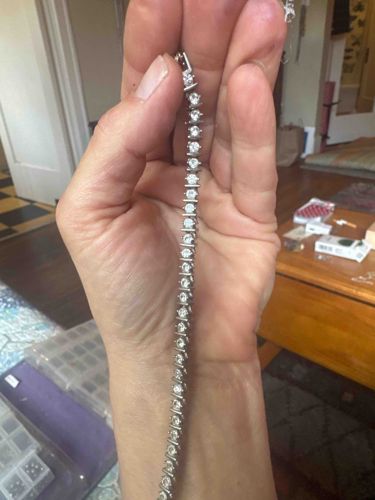
The item is a tennis bracelet, characterized by its continuous string of identically cut diamonds or gemstones linked together. The bracelet appears to be made of a white metal, likely silver, white gold, or platinum, given its bright, reflective luster. It features numerous small, round, brilliant-cut stones, which are likely diamonds or high-quality diamond simulants, each individually set in a four-prong or possibly bezel setting that allows maximum light interaction. The settings are designed to be thin and delicate, creating a fluid, seamless line of sparkle when worn. The visible clasp mechanism near the top of the image indicates a secure closure, essential for this type of bracelet. There are no obvious signs of significant damage or repair, and the overall condition appears good, with the metal showing minimal tarnish or scratches. The stones appear clear and well-matched in size and brilliance, suggesting a certain level of quality craftsmanship. Due to its classic design, it is challenging to estimate an exact age without hallmarks, but this style has been popular since the late 20th century. No specific maker's marks or signatures are discernible from the image.
AI Appraisal Report
I have visually examined the Diamond Tennis Bracelet presented. The item appears to be in good overall condition, with no obvious signs of significant damage, heavy wear, or poor repair from the image provided. The metal, likely white gold or sterling silver, shows appropriate luster for its assumed composition. The stones appear clear, uniformly sized, and well-matched in brilliance, suggesting they are either diamonds or high-quality simulants. The setting style, likely four-prong, maximizes light interaction, contributing to the bracelet's overall sparkle.
Market conditions for classic tennis bracelets remain stable, driven by consistent demand for versatile, timeless jewelry. This style is not particularly rare, but the quality of the stones and metal heavily influences value. Factors impacting value include the total carat weight, diamond clarity and color (if natural diamonds), the specific metal (gold vs. silver), and the manufacturer's reputation. Without discerning hallmark (like 14K for gold or 'S925' for silver) the material cannot be confirmed.
It is crucial to note that my assessment of authenticity is limited by visual examination alone. I cannot definitively confirm if these are natural diamonds versus high-quality simulants (e.g., cubic zirconia, moissanite) or the specific metal composition. To provide a definitive appraisal and authenticate the materials, an in-person examination is essential. This would involve specific gravity testing, professional diamond testing (thermal and electrical conductivity), precise measurement of carat weight and stone dimensions, and examination for hallmarks or maker's marks under magnification. Provenance documentation, if available, would also aid in historical context and value determination. Based on generic new value for comparable generic item, the indicated value range is provided considering the market for new similar items made of silver with cubic zirconia, without ability to determine metal or stone type.