AI estimate as of August 6, 2025 · verify with a professional before acting
AI-Generated · Verify before acting
Everything on this page is generated by AI for informational purposes only. AI can make mistakes — the AI may misidentify items or misattribute them (artist, maker, brand, designer, origin, era). This is not an official valuation and should not be used for insurance, sale, tax, estate, legal, or lending purposes — or any decision requiring a certified appraisal. It is not an authoritative claim about any person, brand, or rights holder — do not share or rely on it as a factual statement about a third party. Always consult qualified professionals before making financial decisions.
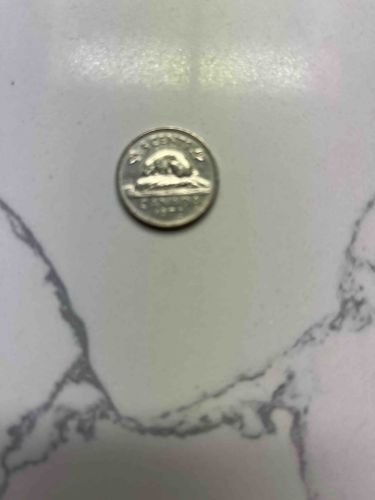
The item is a Canadian 5-cent coin, commonly known as a nickel. It appears to be made of a silver-colored metal, likely nickel or a nickel-plated steel alloy, which is standard for Canadian five-cent pieces. The coin's obverse, visible in the image, features a design of a beaver sitting on a log, above which is the denomination '5 CENTS', and below it, the country name 'CANADA'. The exact year of minting is not clearly discernible due to the image resolution, but the design is consistent with Canadian nickels minted from 1937 onwards. The coin exhibits signs of moderate circulation, indicated by some dulling of its metallic luster and minor surface scratches, particularly on the raised areas of the beaver design and lettering. There are no major dings, dents, or significant wear that would suggest severe damage or an impaired state, appearing to be in good, circulated condition. The craftsmanship appears to be of standard mint quality for a circulating coin, with clear details on the beaver and legible text, even with the slight wear. Based on the visible characteristics, it is a common circulating coin rather than a proof or uncirculated specimen.
AI Appraisal Report
Upon my virtual examination of the provided image of this Canadian 5-Cent Coin, commonly known as a nickel, I can offer the following appraisal. The coin depicts the distinctive beaver design, consistent with Canadian nickels minted from 1937 onwards. Its silver-colored appearance is standard for the type, likely nickel or a nickel-plated steel blend.
In terms of condition, the coin shows clear signs of moderate circulation. The metallic luster is somewhat dulled, and I observe minor surface scratches, particularly on the raised features of the beaver and the lettering. However, there are no apparent major dings, dents, or severe wear that would significantly impair its aesthetic or structural integrity. It appears to be in 'Good, Circulated Condition.' Authenticity, based purely on visual comparison with known examples, seems high; the design elements and overall appearance align with genuine Canadian five-cent pieces of this era. Given it's a common circulating coin, not a proof or uncirculated specimen, its market value is primarily driven by its face value and historical interest.
Market conditions for common circulating Canadian nickels are stable but modest. The demand is low among serious collectors unless it's a rare year, a specific mint error, or in uncirculated condition. This particular coin does not display any immediate characteristics that would suggest significant rarity or a premium value.
The primary factor impacting its value is its status as a common circulating coin with moderate wear. Without the exact year of minting visible, it's impossible to check for specific low mintage varieties which could increase its value. Its main appeal would be to casual collectors or as a historical curiosity, rather than a high-value numismatic item.
It is crucial to note the limitations of this appraisal: authenticity verification is constrained by image quality and the lack of a physical examination. To fully verify authenticity and precisely grade the coin, an in-person inspection would be required to assess edge condition, weight, and to identify any subtle features or marks not visible in the image. Scientific testing (e.g., metal composition analysis) and provenance documentation would confirm its origin and material if ever in doubt. For this common coin, such extensive testing is generally not pursued unless a rare variety is suspected.