AI estimate as of August 17, 2025 · verify with a professional before acting
AI-Generated · Verify before acting
Everything on this page is generated by AI for informational purposes only. AI can make mistakes — the AI may misidentify items or misattribute them (artist, maker, brand, designer, origin, era). This is not an official valuation and should not be used for insurance, sale, tax, estate, legal, or lending purposes — or any decision requiring a certified appraisal. It is not an authoritative claim about any person, brand, or rights holder — do not share or rely on it as a factual statement about a third party. Always consult qualified professionals before making financial decisions.
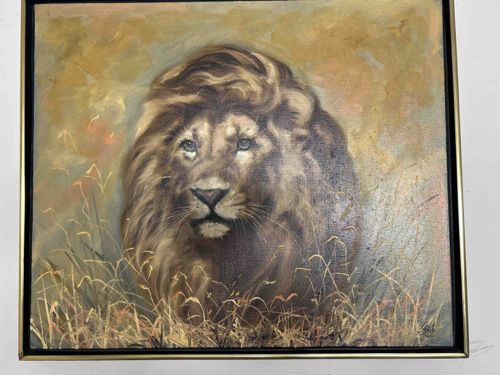
This is an oil painting on canvas depicting a striking portrait of a male lion. The lion is positioned centrally, facing forward with a direct, intense gaze that captures the viewer's attention. Its majestic mane, rendered with visible brushstrokes, shows various shades of brown, tan, and dark amber, providing texture and depth. The lion's eyes are a notable feature, appearing bright blue or light gray, contrasting with its earthy fur tones. The nose is dark and clearly defined, and the mouth is subtly represented. The background suggests a natural habitat, likely a savanna, with muted ochre, gold, and light green hues for the sky or distant foliage, and tall, dry grass in the foreground rendered with fine, vertical strokes of brown and yellow, suggesting movement and depth. The overall color palette is warm and earthy, creating a harmonious and realistic representation. The painting is framed in a simple, thin gold-toned or brass-colored frame, which complements the warm tones of the artwork without distracting from it. There are no immediately apparent signs of significant damage such as tears or major paint loss, but some degree of patina or discolored varnish might be present, typical of an older oil painting. The craftsmanship appears to be of good quality, with attention to detail in the lion's facial features and the texture of its fur. Without a visible signature or date, the precise artist and age are difficult to determine, but the style suggests a mid-to-late 20th century wildlife art aesthetic.
AI Appraisal Report
This oil painting on canvas, 'Portrait of a Lion,' presents as a well-executed piece with a strong visual presence. Based on my visual examination, the condition appears good, with no obvious signs of significant damage such as tears or major paint loss. The suggestion of patina or discolored varnish is common for older oil paintings and, if present, would be consistent with its likely age. Authenticity, solely based on images, is limited. I observe a professional standard of craftsmanship, particularly in the lion's detailed features and fur texture. The absence of a visible signature or date hinders definitive attribution. The style, characterized by realistic depiction and warm, earthy tones, strongly suggests a mid-to-late 20th-century wildlife art aesthetic.
In terms of market conditions, wildlife art, particularly well-executed animal portraits, consistently finds an audience. While it may not command the same prices as contemporary avant-garde or historical masterworks, there is a steady demand from collectors and decorators. Comparables for unsigned 20th-century wildlife oil paintings of this scale and quality typically fall within a modest to mid-range. Factors impacting value include the lack of artist attribution, which prevents establishing a market history for the painter. Should a renowned wildlife artist be identified, the value would significantly increase. Rarity is difficult to assess without provenance. The simplicity of the frame complements the artwork without adding significant value.
For full authenticity verification, an in-person examination is crucial to assess surface condition, paint layer integrity, and potential hidden signatures or inscriptions. Provenance documentation, such as purchase receipts or exhibition history, would be invaluable in establishing the artist and history. Scientific testing, such as pigment analysis or carbon dating, could help confirm the age of the materials, corroborating the estimated mid-to-late 20th-century period. Without these, the appraisal remains based on aesthetic merit and general market trends for unsigned works of this nature.