These notes were written by the person who submitted this item. Appraiser.AI has not verified them, and the AI's identification and estimate may rely on them.
AI Estimated Value
Not an official valuation
$60-120
AI estimate as of November 4, 2025 · verify with a professional before acting
AI-Generated · Verify before acting
Everything on this page is generated by AI for informational purposes only. AI can make mistakes — the AI may misidentify items or misattribute them (artist, maker, brand, designer, origin, era). This is not an official valuation and should not be used for insurance, sale, tax, estate, legal, or lending purposes — or any decision requiring a certified appraisal. It is not an authoritative claim about any person, brand, or rights holder — do not share or rely on it as a factual statement about a third party. Always consult qualified professionals before making financial decisions.
This analysis also relies on unverified notes provided by the user, which may be incomplete or inaccurate and could affect the result.
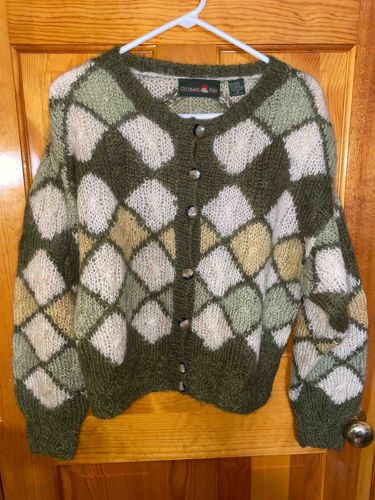
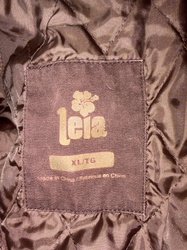
This is a vintage women's cardigan sweater, likely from the late 20th century, featuring a distinctive argyle pattern. The primary colors are various shades of green, cream/off-white, and a light yellowish-beige. The sweater is constructed from a blend of mohair and wool, as indicated by the context, which gives it a soft, slightly fuzzy texture and substantial feel. The dominant color for the background and ribbed trims (neckline, cuffs, and hem) is a dark olive or forest green. The argyle diamonds are knitted in contrasting shades: cream/off-white, a lighter sage green, and a pale yellow-beige. These color blocks are well-defined, suggesting a jacquard knitting technique. The cardigan features a crew neck, a full button-front closure, and long sleeves. There are seven visible buttons, which appear to be antique silver-toned metal, possibly etched or textured. The hem and cuffs are finished with a ribbed knit, providing a snugger fit. A notable feature is the 'OUTBACK RED' brand label sewn into the neckline, confirming its manufacturer. The garment appears to be in good vintage condition, exhibiting some natural pilling or 'halo' effect common for mohair and wool blends, but no obvious tears, stains, or significant damage. The overall construction shows good craftsmanship with consistent stitching and pattern alignment. The 'outback red' context likely refers to the brand name, not the color of the item itself.
AI Appraisal Report
Upon examining the provided image and information for this Vintage Outback Red Argyle Mohair and Wool Cardigan, I can offer the following appraisal. The condition appears to be good vintage, with the natural pilling or 'halo' effect typical of mohair and wool blends. No obvious tears, stains, or significant damage are visible, suggesting it has been well-preserved. The 'OUTBACK RED' label confirms its manufacturer, and its vintage designation places it likely in the late 20th century. Authenticity of the brand is supported by the label, though limitations exist without physical examination.
From a market perspective, vintage mohair and wool cardigans, especially those with classic argyle patterns, currently enjoy moderate demand. While not a high-luxury brand, 'Outback Red' is a recognizable label in vintage circles. Comparables for similar vintage mohair/wool argyle cardigans from non-designer brands typically range from $50 to $150, depending on condition, specific pattern, and colorway. The appealing green, cream, and yellow-beige argyle pattern on a dark green background is a desirable combination, contributing positively to its value.
Factors significantly impacting value include the material composition (mohair and wool are sought after for their warmth and texture), the classic argyle design, and its overall good condition. Rarity is not exceptionally high for this particular brand or style, but well-maintained vintage pieces always hold some value.
My assessment of the good vintage condition and authenticity is based solely on the visual evidence. For full authentication and a definitive condition report, an in-person examination would be crucial to assess tactile qualities, confirm fiber composition without doubt, check for any subtle flaws (e.g., moth holes, stretched areas, faint discoloration) not visible in images, and verify the integrity of seams and buttons. Provenance documentation could further establish its history, but this is less common for items of this price point.