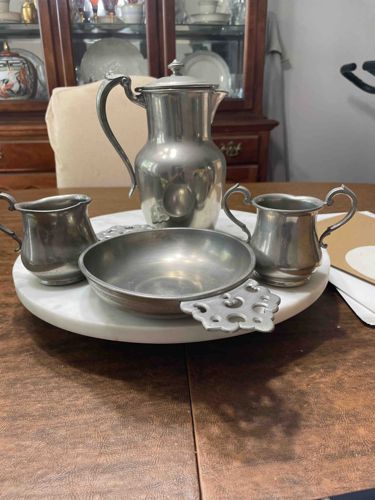
Pewter breakfast set. Porringer, Coffee pot, cream and sugar containers
These notes were written by the person who submitted this item. Appraiser.AI has not verified them, and the AI's identification and estimate may rely on them.
AI Estimated Value
Not an official valuation
$300-500
AI estimate as of August 11, 2025 · verify with a professional before acting
AI-Generated · Verify before acting
Everything on this page is generated by AI for informational purposes only. AI can make mistakes — the AI may misidentify items or misattribute them (artist, maker, brand, designer, origin, era). This is not an official valuation and should not be used for insurance, sale, tax, estate, legal, or lending purposes — or any decision requiring a certified appraisal. It is not an authoritative claim about any person, brand, or rights holder — do not share or rely on it as a factual statement about a third party. Always consult qualified professionals before making financial decisions.
This analysis also relies on unverified notes provided by the user, which may be incomplete or inaccurate and could affect the result.
This is a five-piece pewter breakfast set, including a coffee pot, a cream pitcher, a sugar bowl, a porringer, and a small decorative plate. All pieces exhibit a matte, satiny grey finish typical of pewter, with a slight sheen indicating a well-maintained surface for their age. The coffee pot is tall and slender with a hinged lid, an elegant C-scroll handle, and a defined spout, displaying classic proportions. The cream pitcher and sugar bowl are smaller, matching in style with rounded bodies and delicate, ornate handles that suggest an aesthetic influence from the late 19th to early 20th century. The porringer is a shallow bowl with a single, flat, elaborate handle featuring an openwork, stylized floral or scroll design, characteristic of traditional porringer handles. The small decorative plate, possibly a coaster or serving dish for a single item, echoes this intricate openwork pattern, suggesting a cohesive set design. There are no immediate visible signs of major damage like dents or cracks, but the surface shows a natural aged patina consistent with pewter, adding to its character without detracting from its appearance. No specific maker's marks or signatures are discernible from the provided images, which might suggest a broader production or a less prominent manufacturer. The uniform appearance and matching design elements across all pieces indicate a complete and original set. The craftsmanship appears to be of good quality, with smooth transitions between components and well-formed handles, suggesting a reputable manufacturing process.
AI Appraisal Report
Upon examining the provided images of this five-piece pewter breakfast set, which includes a coffee pot, cream pitcher, sugar bowl, porringer, and small decorative plate, I can confirm its apparent completeness and aesthetic coherence. The uniform matte, satiny grey finish with a slight sheen suggests a well-maintained surface, consistent with aged pewter. There are no visible signs of major damage like dents or cracks, and the aged patina is natural for pewter, enhancing its character. The design elements, particularly the ornate handles and openwork patterns on the porringer and decorative plate, point to a late 19th to early 20th-century aesthetic influence. This era aligns well with popular pewter production.
In terms of market conditions, antique pewter sets, especially those that are complete and in good condition, generally maintain a steady demand among collectors of historical serveware. However, the absence of discernible maker's marks is a significant factor. While the craftsmanship appears good, the lack of a known manufacturer limits its appeal to specialized collectors who prioritize pieces from renowned makers. Comparable, unmarked pewter sets of this period tend to fetch lower prices than those with strong provenance or maker identification. The rarity is moderate; while complete sets are less common than individual pieces, similar unmarked sets do appear on the market periodically. Without a specific maker, the value is driven more by condition, aesthetic appeal, and completeness rather than historical significance tied to a specific producer.
My assessment of authenticity is based solely on visual cues from the images provided. The material appears consistent with pewter of the described period. However, a definitive authentication would require an in-person examination to verify metal composition through scientific testing (e.g., XRF analysis), look for micro-stamping or faint marks not visible in images, and thoroughly assess construction techniques. Provenance documentation, if available, would significantly enhance authenticity and value. The current limitations mean I cannot definitively rule out that this is not an excellent quality reproduction without a physical inspection, though its appearance strongly suggests period originality.