These notes were written by the person who submitted this item. Appraiser.AI has not verified them, and the AI's identification and estimate may rely on them.
AI Estimated Value
Not an official valuation
$15-25
AI estimate as of September 2, 2025 · verify with a professional before acting
AI-Generated · Verify before acting
Everything on this page is generated by AI for informational purposes only. AI can make mistakes — the AI may misidentify items or misattribute them (artist, maker, brand, designer, origin, era). This is not an official valuation and should not be used for insurance, sale, tax, estate, legal, or lending purposes — or any decision requiring a certified appraisal. It is not an authoritative claim about any person, brand, or rights holder — do not share or rely on it as a factual statement about a third party. Always consult qualified professionals before making financial decisions.
This analysis also relies on unverified notes provided by the user, which may be incomplete or inaccurate and could affect the result.
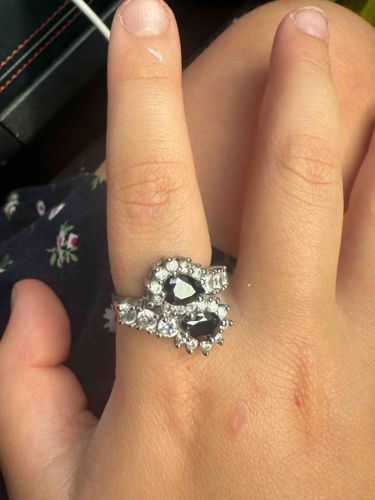
This item is a fashion ring, likely retrieved from a candle as per the additional context. It features a prominent cluster design on the top, appearing to be composed of a silver-toned metal, possibly sterling silver or a base metal with rhodium plating, given its bright, reflective surface. The ring showcases two main pear-shaped black gemstones, likely cubic zirconia, onyx, or another dark opaque stone, which serve as focal points. These black stones are surrounded by numerous smaller, round, clear or colorless gemstones, also likely cubic zirconia or glass, set in a pave or prong setting to maximize sparkle. There are approximately 25-30 smaller clear stones visible, surrounding the two central black stones and extending onto the shoulders of the band. The setting appears to be a multi-tiered or raised design, giving the ring a substantial presence on the finger. The condition appears to be good, with no obvious signs of significant damage, scratches, or missing stones. The prongs holding the stones appear intact. The craftsmanship suggests a mass-produced item, common in costume or fashion jewelry. There are no discernible maker's marks or signatures visible from the image. Given its design and potential origin from a candle, it is likely a modern piece, manufactured within the last decade or two, intended as an affordable fashion accessory rather than fine jewelry with significant intrinsic value.
AI Appraisal Report
Upon examination of the provided image, this item presents as a fashion cluster ring. The design features a silver-toned metal, which, given its bright finish, is likely a rhodium-plated base metal or potentially sterling silver, though I cannot confirm this without material testing. The centerpiece consists of two pear-shaped, opaque black stones, surrounded by numerous small, round, colorless stones. Based on the context of fashion jewelry, particularly items retrieved from candles, these stones are presumed to be non-precious materials such as cubic zirconia, glass, or synthetic spinel. The craftsmanship is consistent with mass-produced costume jewelry.
The condition appears good from the visual inspection, with all stones present and accounted for and no obvious damage to the settings or band. However, a significant factor impacting the value is its origin. As a 'candle ring,' it is part of a category of novelty items rather than fine jewelry. The market for such pieces is driven by novelty and aesthetics, not intrinsic material value. Comparable mass-produced fashion rings of this style and material composition typically retail for a low price. Demand is limited to the costume jewelry market, and the item holds no rarity.
My valuation of $15-25 reflects its worth as a secondary market fashion accessory. It is crucial to note the limitations of this appraisal. Without physical inspection, I cannot verify the metal content, identify the specific types of stones, or locate any potential maker's marks. A definitive assessment would require in-person examination, including gemstone and metal testing, to rule out the small possibility of genuine materials.