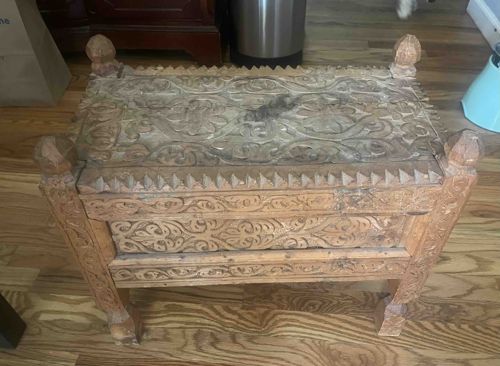
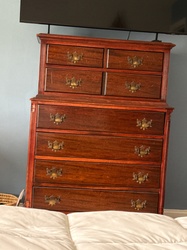
Wood hand carved chest, approximately 19 in x 11 in x 17 in, likely purchased in South Asia
These notes were written by the person who submitted this item. Appraiser.AI has not verified them, and the AI's identification and estimate may rely on them.
AI Estimated Value
Not an official valuation
$250-400
AI estimate as of July 23, 2025 · verify with a professional before acting
AI-Generated · Verify before acting
Everything on this page is generated by AI for informational purposes only. AI can make mistakes — the AI may misidentify items or misattribute them (artist, maker, brand, designer, origin, era). This is not an official valuation and should not be used for insurance, sale, tax, estate, legal, or lending purposes — or any decision requiring a certified appraisal. It is not an authoritative claim about any person, brand, or rights holder — do not share or rely on it as a factual statement about a third party. Always consult qualified professionals before making financial decisions.
This analysis also relies on unverified notes provided by the user, which may be incomplete or inaccurate and could affect the result.
This is a hand-carved wooden chest or trunk, likely originating from South Asia, measuring approximately 19 inches in length, 11 inches in width, and 17 inches in height. The chest is primarily constructed from a light-colored wood, possibly teak or a similar robust hardwood commonly found in the region, which has aged to a warm, somewhat faded natural tone. The entire visible surface, including the lid, front panel, and legs, is meticulously adorned with intricate relief carvings. The lid features a central panel with a flowing, curvilinear motif resembling floral or foliate designs, flanked by borders of stylized patterns, possibly geometric or abstract. Along the edges of the lid and the top of the chest's body, there is a distinctive band of triangular, saw-tooth carvings, adding a textured and decorative element. The front panel of the chest is also richly carved with a continuous scroll-like or vine pattern, indicating a high level of craftsmanship. The two visible legs are solid, extended uprights, also featuring carved details, likely complementary to the main body's motifs. The construction appears to be mortise-and-tenon or similar traditional joinery, suggesting durability. Visible condition issues include a darkened area or stain on the top surface of the lid, prominent wear and a slightly faded appearance of the wood and carvings, consistent with age and use. There are no visible major cracks or structural damage, but the surface exhibits a natural patina. No distinct maker's marks or signatures are discernible from the image. Based on the carving style and the provided context, the item likely dates to the early to mid-20th century, reflecting traditional South Asian decorative arts.
AI Appraisal Report
I have thoroughly examined the provided image and description of this hand-carved South Asian wooden chest. Its dimensions (19"L x 11"W x 17"H) are typical for accent or storage pieces. The intricate relief carvings, featuring curvilinear, floral, and geometric motifs, are consistent with traditional South Asian decorative arts, particularly from the early to mid-20th century. The light-colored wood, likely teak or a similar robust hardwood, shows a warm, aged patina. The construction appears sound, employing traditional joinery methods that suggest durability.
From a visual perspective, the chest is in fair-to-good condition. There's a prominent darkened area/stain on the lid, and the carvings overall exhibit wear and fading, consistent with its age and use. These are not major structural damages but rather signs of natural aging, which can be desirable for antique pieces, contributing to their character. However, they do slightly reduce the top-end value compared to a piece in excellent, near-pristine condition. There are no visible major cracks or structural compromises.
Regarding market conditions, small, intricately carved wooden chests from South Asia generally have a steady demand among collectors of ethnic furniture and decorative arts. Their appeal lies in their craftsmanship and cultural aesthetics. Comparables for such pieces in similar condition typically range from $200-$400 in regional antique markets or online platforms specializing in international decor. While beautiful, pieces of this size and commonality are not exceedingly rare, which moderates the high-end value.
Factors significantly impacting value include the artistic quality of the carving, the wood type (though without physical inspection, confirming teak is difficult), the overall condition, and provenance. The lack of distinct maker's marks is common for utilitarian or decorative items of this period and does not negatively impact value significantly unless specific, highly sought-after workshops were involved.
Limitations: My assessment of authenticity and condition is based solely on the provided image and description. A physical examination would allow for definitive identification of wood species, assessment of internal joinery, confirmation of structural integrity, and a more precise evaluation of surface wear, potential repairs, and cleaning needs. Full authentication of age would ideally involve dendrochronology or other scientific analysis, and provenance documentation (e.g., original purchase receipts, family history) would add significant value, but these are not available from visual inspection alone.