AI Appraisal Estimate

AI-generated estimates · not official valuations

From the user

What was submitted

Photo and notes provided by the user — not generated by AI

Submitted item photo
Submitted photo · June 23, 2026

User's notes

No additional notes provided.

AI analysis below

AI appraisal

AI analysis & estimate

AI-Generated · Verify before acting

Everything below is generated by AI for informational purposes only. AI can make mistakes — the AI may misidentify items or misattribute them (artist, maker, brand, designer, origin, era). This is not an official valuation and should not be used for insurance, sale, tax, estate, legal, or lending purposes — or any decision requiring a certified appraisal. It is not an authoritative claim about any person, brand, or rights holder — do not share or rely on it as a factual statement about a third party. Always consult qualified professionals before making financial decisions.

Read the full disclaimer

AI Identification

·Not independently authenticated·Verify before acting

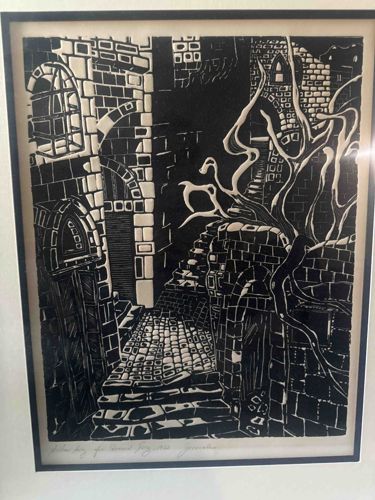
Framed Black and White Linocut Print "Jerusalem Alley"

Art Print

AI Estimated Value

·Not an official valuation·Verify before acting

$250-450

As of June 23, 2026

AI Item Analysis

·AI can make mistakes·Verify before acting
This item is a framed linocut print, executed in a striking monochrome palette of black and white, depicting a narrow, winding alleyway, likely within an ancient city, suggestive of Jerusalem. The print features a highly textured composition, achieved through the linocut process, where white areas rise slightly from the black background, creating a tactile and three-dimensional effect. The scene is characterized by intricate brickwork on buildings and archways, an uneven cobblestone path receding into the background, and a prominent, gnarled tree or root system on the right, spiraling upwards. Architectural details include arched windows with grids and doorways. The contrast between light and shadow is stark, enhancing the dramatic and historic feel of the scene. Visible near the bottom left corner, handwritten text in pencil appears to include 'Jerusalem Alley' or similar, confirming the subject matter, along with what could be a signature and possibly a limited edition number or date. The print is housed under glass in a simple black frame, which appears to be in good condition. No significant damage or wear is immediately apparent on the print itself, though minor dust or reflections are visible on the glass. The style suggests a mid-20th century to contemporary period, embracing a graphic, expressive aesthetic typical of relief printing. The craftsmanship is evident in the detailed carving and the strong visual impact of the composition.

AI Appraisal Report

·AI can make mistakes·Verify before acting
I have examined the provided image of the framed black and white linocut print titled "Jerusalem Alley." Visually, the print appears to be in very good condition with no obvious damage or significant discoloration. The simple black frame is also in good condition. The linocut technique is well-executed, creating a tactile and dramatic composition. The handwritten text at the bottom left, specifically 'Jerusalem Alley' and a potential signature/edition number, increases its personal and authentic appeal. However, verifying the authenticity of this signature or edition number definitively from an image alone is impossible. This piece taps into a market for graphic, expressive relief prints, particularly those depicting historical or architectural scenes. Demand for original prints of this style is consistent, though not typically high-end unless by a well-established artist. The subject matter of Jerusalem adds specific appeal to collectors interested in Judaica or Middle Eastern art. Without a known artist, the value relies more on aesthetic quality and condition. Comparable sales of similar good quality, unsigned or lesser-known artist linocuts of architectural scenes typically fall within this range. Several factors impact value: the unknown artist is the primary limitation. Rarity is difficult to ascertain without an edition number and artist-specific information. Full authentication would require a physical inspection to verify the signature and medium, assess paper quality, and examine for any hidden damage or repairs. Provenance documentation, such as a certificate of authenticity or exhibition history, would significantly enhance its value and confirm its origins.

Get your items appraised

Instant estimates of your treasures with AI-powered appraisals

Browse More Appraisals