AI estimate as of October 22, 2025 · verify with a professional before acting
AI-Generated · Verify before acting
Everything on this page is generated by AI for informational purposes only. AI can make mistakes — the AI may misidentify items or misattribute them (artist, maker, brand, designer, origin, era). This is not an official valuation and should not be used for insurance, sale, tax, estate, legal, or lending purposes — or any decision requiring a certified appraisal. It is not an authoritative claim about any person, brand, or rights holder — do not share or rely on it as a factual statement about a third party. Always consult qualified professionals before making financial decisions.
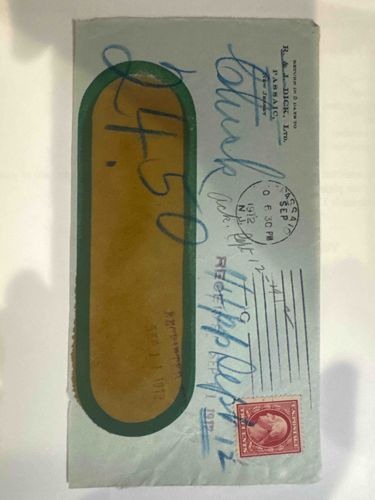
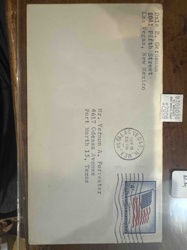
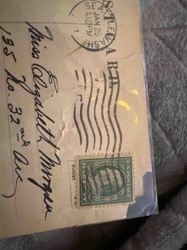
This item is a vintage, light blue-grey commercial window envelope, featuring a prominent rectangular cutout with rounded corners on the left side, designed to display the recipient's address from the enclosed letter. The window is bordered by a dark green frame, while the interior of the window itself appears to be a light brown or tan color, possibly indicating an aged clear film or the color of the paper behind it. The envelope is addressed to 'Thick' in large, looping blue script, with 'Jack. Espt.' (possibly 'Esq.') written below, all in the same blue ink. In the upper right corner, there is a red one-cent U.S. postage stamp depicting Benjamin Franklin, which has been canceled with a circular postmark indicating 'PASSARC, N.J.' and the date 'SEP 6 30 PM 1912'. Further markings in blue ink include 'Rec'd F.C.F. 12' and '1912'. Additionally, there's a handwritten price '24.50' marked in blue script over the window area, suggesting a past sales price or appraisal. The return address, printed in the upper left corner, reads 'RETURN IF UNDELIV. to R.R. DICK, LTD. PASSAIC, New Jersey'. Another handwritten date, 'SEP 1 1972', is visible near the bottom of the window, indicating a much later date of handling or cataloging. The overall condition shows signs of age as expected for an item over a century old, including slight creases, discoloration of the paper, and general wear from handling and storage. The edges appear somewhat softened, and there may be minor tears not clearly discernible in the image. The paper exhibits a slight sheen, possibly due to its age or initial quality. The blue ink handwriting is legible and vibrant, contrasting well with the pale envelope color. The item serves as a historical artifact, offering insight into early 20th-century commercial correspondence and postal practices.
AI Appraisal Report
I have carefully examined the provided image of this Vintage R.R. Dick Ltd. Window Envelope with a 1912 Postmark. Authenticity appears good for an item of this type; the cancellations, stamp, and printing styles are consistent with the period. The envelope exhibits expected signs of age, including discoloration, softening of edges, and minor creasing, which aligns with its age of over a century. The blue ink handwriting is legible and vibrant. The handwritten ‘24.50’ likely indicates a past retail price, which was perhaps high for such an item. The handwritten ‘SEP 1 1972’ suggests it was cataloged much later.
From a market perspective, this is a common commercial window envelope, and while the 1c Franklin stamp is period-correct, it is not particularly rare. The ‘PASSARC, N.J.’ postmark is interesting but not a significant value driver unless it's an unusually rare cancellation for that locality. The recipient's name ‘Thick’ and ‘Jack. Espt.’ do not appear to be significant historical figures, which would otherwise enhance value. Demand for common commercial covers, even those over 100 years old, is moderate.
The primary value comes from its intact condition for its age and the completeness of the postal history elements (stamp, postmark, return address). However, factors limiting higher value include the commonness of the stamp, the commercial nature of the envelope, and the lack of exceptionally rare postal markings or significant historical association. Without physical inspection, I cannot confirm the integrity of the paper or detect any repairs or alterations that might not be visible in the image. Full authentication would require in-person examination to verify paper quality, ink consistency, and any hidden flaws. Based on visual examination alone, I estimate its current market value to be in the range of $25-$50.