These notes were written by the person who submitted this item. Appraiser.AI has not verified them, and the AI's identification and estimate may rely on them.
AI Estimated Value
Not an official valuation
$150-300
AI estimate as of December 1, 2025 · verify with a professional before acting
AI-Generated · Verify before acting
Everything on this page is generated by AI for informational purposes only. AI can make mistakes — the AI may misidentify items or misattribute them (artist, maker, brand, designer, origin, era). This is not an official valuation and should not be used for insurance, sale, tax, estate, legal, or lending purposes — or any decision requiring a certified appraisal. It is not an authoritative claim about any person, brand, or rights holder — do not share or rely on it as a factual statement about a third party. Always consult qualified professionals before making financial decisions.
This analysis also relies on unverified notes provided by the user, which may be incomplete or inaccurate and could affect the result.
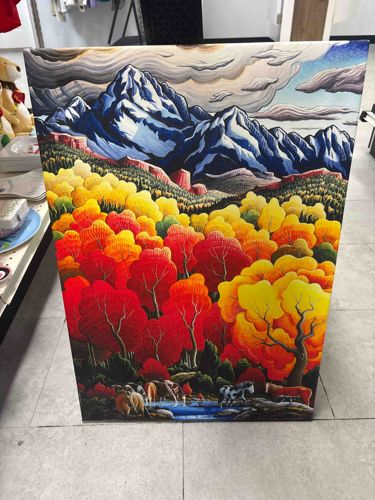
This item is an unframed canvas painting depicting a vibrant mountain landscape in an autumn setting, characterized by its bold colors and somewhat stylized representation of nature. The dominant features include majestic, snow-capped mountains rendered in shades of blue, white, and gray, set against a dynamic sky with both clear blue patches and heavy, textured gray clouds. Below the mountains, a rich forest is shown in full autumn glory, with trees displaying intensely saturated colors ranging from deep reds and oranges to bright yellows and golds. The foliage is depicted with a textured quality, suggesting individual leaves or clusters, particularly in the foreground. Towards the bottom of the painting, a calm body of water, likely a river or pond, reflects the sky, and several livestock animals, possibly cows or sheep, are gathered near the water's edge, some appearing to drink. The brushwork appears to be textured, adding depth and a tactile quality to the colors. The overall aesthetic leans towards a folk art or perhaps a contemporary naive art style, with clear outlines and distinct color blocks rather than subtle blending. The painting is rectangular, presented on what appears to be a wrapped canvas, suggesting it is gallery-wrapped or a print on canvas. No visible damage such as tears, punctures, or significant scuffs are apparent from the provided images, indicating good overall condition. There are no discernible artist signatures or marks visible on the front.
AI Appraisal Report
I have examined the provided image of the 'Mountain Landscape with Autumn Trees and Livestock Painting.' The piece appears to be in good overall condition, with no visible damage such as tears, punctures, or significant scuffs, which is a positive factor. The aesthetic leans towards a folk art or contemporary naive style, characterized by bold colors, clear outlines, and textured brushwork. This style can have a niche market appeal.
However, several factors significantly impact its value. The absence of a visible artist's signature or any identifying marks on the front makes attribution impossible from images alone. Without an artist, the piece is generally valued as decorative art. The description mentions it is an unframed canvas, depicting it as either gallery-wrapped canvas or a print on canvas, which also affects the appraisal. If it's a print, its value would be significantly lower than an original painting. The 'textured quality' could indicate impasto paint on an original, or a textured print.
Market conditions for unsigned decorative folk art landscapes of this type typically place them in the lower-to-mid range. Demand exists for appealing decorative pieces, but rarity is not a factor here due to the lack of artist identification. Comparable items often sell in the $100-$400 range, depending on quality, size, and whether they are original paintings or prints.
For full authentication and a more precise appraisal, a physical in-person examination would be crucial to determine whether this is an original painting (oil or acrylic) or a print on canvas. Scientific testing of the medium and canvas, along with any provenance documentation, would be necessary to establish authenticity and potentially identify an artist, which could significantly alter the value.