These notes were written by the person who submitted this item. Appraiser.AI has not verified them, and the AI's identification and estimate may rely on them.
AI Estimated Value
Not an official valuation
$350-650
AI estimate as of June 27, 2025 · verify with a professional before acting
AI-Generated · Verify before acting
Everything on this page is generated by AI for informational purposes only. AI can make mistakes — the AI may misidentify items or misattribute them (artist, maker, brand, designer, origin, era). This is not an official valuation and should not be used for insurance, sale, tax, estate, legal, or lending purposes — or any decision requiring a certified appraisal. It is not an authoritative claim about any person, brand, or rights holder — do not share or rely on it as a factual statement about a third party. Always consult qualified professionals before making financial decisions.
This analysis also relies on unverified notes provided by the user, which may be incomplete or inaccurate and could affect the result.
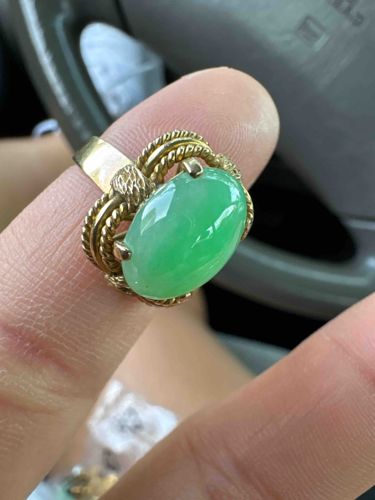
This item is a vintage-style ring featuring an oval-shaped, cabochon-cut jade gemstone set in a gold-toned metal band. The jade exhibits a vibrant, translucent apple-green color, typical of high-quality jadeite. The stone is smoothly polished and appears to be in excellent condition with no visible chips, cracks, or significant abrasions. The ring's setting is a bezel or prong-set style, securely holding the jade with four visible prongs. The gold-toned metal work around the oval stone features an intricate, somewhat ornate design, possibly with rope-like or braided textures and possibly thistle-like or floral motifs on the shoulders, suggesting a more classic or vintage aesthetic. The band itself appears to be a solid but relatively thin shank. The metal shows some minor surface wear consistent with age and use, including potential slight scratches or patina, but no immediate signs of major damage or repair are discernible from the image. The craftsmanship appears to be of good quality, with well-formed metalwork and a securely set stone. Without visible hallmarks, the exact metal composition (e.g., karat gold, gold fill, or plated) or maker cannot be definitively identified. Its overall style suggests an estimated age from the mid-20th century to possibly early contemporary, drawing inspiration from antique designs.
AI Appraisal Report
Based on my remote examination of the provided image and the owner's description of the Vintage-Style Oval Jade and Gold-Tone Ring, I offer the following appraisal. The ring presents with a vibrant, translucent apple-green cabochon jade, which, if truly jadeite as suggested by its color and translucency, would be a significant factor in its value. The stone appears to be in excellent condition, free from visible chips or cracks. The gold-toned setting features an intricate, ornate design consistent with a vintage aesthetic, likely from the mid-20th century or later, drawing inspiration from antique styles. While the metal shows minor surface wear, it appears structurally sound.
From the image alone, I cannot definitively confirm if the jade is natural jadeite, nephrite, or a simulant, nor can I ascertain the precise metal composition (e.g., solid gold, gold-filled, or plated). The quality of the metalwork, while good, lacks visible hallmarks, which limits identification of the maker or specific karatage. Market demand for vintage jade jewelry is generally stable, particularly for pieces featuring high-quality jadeite. However, without in-person inspection, including gemological testing for the jade (refractive index, specific gravity) and metal testing (XRF analysis), the authenticity of these key components remains an assumption.
For full authentication and a more precise valuation, I would require hands-on examination to verify the jade's type and quality, assess the metal's composition, and thoroughly inspect for any repairs or hidden damages. Provenance documentation, if available, would also be highly beneficial. The current valuation reflects the potential for genuine high-quality jade and decent craftsmanship, while accounting for the limitations of a visual-only appraisal.