AI estimate as of August 7, 2025 · verify with a professional before acting
AI-Generated · Verify before acting
Everything on this page is generated by AI for informational purposes only. AI can make mistakes — the AI may misidentify items or misattribute them (artist, maker, brand, designer, origin, era). This is not an official valuation and should not be used for insurance, sale, tax, estate, legal, or lending purposes — or any decision requiring a certified appraisal. It is not an authoritative claim about any person, brand, or rights holder — do not share or rely on it as a factual statement about a third party. Always consult qualified professionals before making financial decisions.
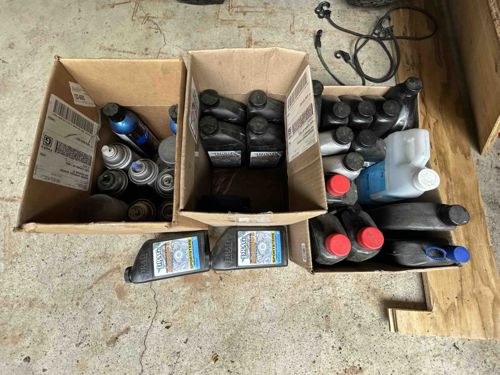
This collection consists of various automotive or household fluids and aerosol cans, largely contained within three open cardboard boxes, with some items spilling out onto the concrete floor and a wooden surface. The fluids are primarily housed in plastic bottles of varying sizes and colors, including black, white, and a light blue. Some of these bottles feature red caps, while others have black or blue caps. Two black plastic bottles with distinctive orange and blue labels featuring 'TRITON' branding are visible at the bottom left, suggesting they contain a specific type of oil or fluid. A bundle of tangled electrical cords, possibly jump cables or an extension cord, is also visible near the top right of the central box. The aerosol cans, many of which appear to be spray paints or lubricants, are stored in the leftmost box. These cans are predominantly silver, with some exhibiting blue-colored tops. The overall condition suggests that these items are used or stored surplus, with some dust and grime visible on the bottles and boxes, indicative of a garage or storage environment. The cardboard boxes themselves show signs of wear and tear, consistent with storage and handling. There are no clear indications of manufacturing dates or specific model numbers universally across the items, but the diverse assortment suggests a collection of maintenance or utility products.
AI Appraisal Report
Upon my virtual inspection of the Assorted Automotive/Household Fluids & Aerosol Cans, I find this collection to be in fair, used condition, consistent with a garage or hobbyist's stock. The items are not new; dust and wear on the bottles, cans, and cardboard boxes suggest prolonged storage and use. Authenticity, in this context, refers primarily to the genuine nature of the products as marketable fluids and aerosols rather than counterfeits. Based on visual cues like brand labeling (e.g., 'TRITON'), they appear to be legitimate, commercially produced items. However, without physical inspection, I cannot verify the integrity of the seals, the exact volume remaining in partially used containers, or the presence of any adulteration.
Market conditions for such used, assorted fluids and aerosols are highly localized and demand-driven. These items are generally purchased for their utility rather than collector's value. Comparables would include lots sold at garage sales, online marketplace listings (like Facebook Marketplace or Craigslist), or estate sales. A new bottle of engine oil can cost \$5-\$10, and a new spray can \$3-\$7. This lot, being used and mixed, would command significantly less.
Demand is low for bulk, used automotive/household fluids, as consumers typically prefer new, sealed products for assured quality and safety. Rarity is not a factor; these are common, utilitarian products. Factors significantly impacting value include the unknown fill levels, potential degradation of the fluids over time, and the highly practical nature of the items. The tangled electrical cords add marginal, if any, value.
Limitations in authenticity verification are significant. A full authentication would require in-person examination to check for tampering, inspect seals, and assess the actual remaining volume and condition of the liquids/aerosols. Provenance documentation would be useful to ascertain purchase dates and storage history, but is highly unlikely for such items. Scientific testing would be necessary to verify the chemical integrity and efficacy of the fluids, which is impractical for an appraisal of this nature.