AI estimate as of September 16, 2025 · verify with a professional before acting
AI-Generated · Verify before acting
Everything on this page is generated by AI for informational purposes only. AI can make mistakes — the AI may misidentify items or misattribute them (artist, maker, brand, designer, origin, era). This is not an official valuation and should not be used for insurance, sale, tax, estate, legal, or lending purposes — or any decision requiring a certified appraisal. It is not an authoritative claim about any person, brand, or rights holder — do not share or rely on it as a factual statement about a third party. Always consult qualified professionals before making financial decisions.
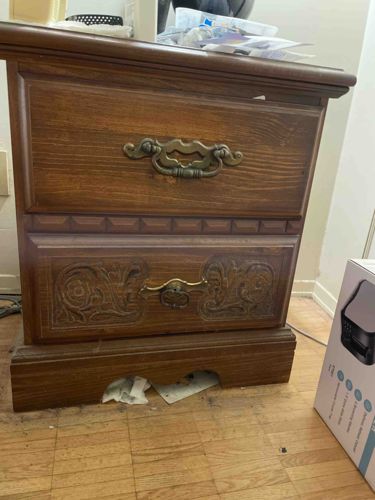
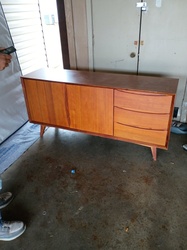
This item is a two-drawer wooden nightstand, characterized by its medium-to-dark brown finish which highlights the prominent wood grain, suggesting a solid wood construction or high-quality wood veneer. The overall aesthetic is traditional, possibly reflecting a Spanish Colonial or Provincial style from the mid-20th century, likely 1950s-1970s. The nightstand features two drawers stacked vertically. The top drawer has a recessed panel with a simpler, less ornate design but still showcasing the wood grain. The lower drawer is more decorative, featuring extensive carved details on its front panel, including floral or scroll motifs that add a touch of elegance and craftsmanship. Each drawer is fitted with a single, ornate brass-toned pull handle, suggesting cast metal, presenting a classic curvilinear form with a central grip. The hardware shows some patina consistent with age. The nightstand stands on a solid plinth base, which has a cut-out area at the bottom front, possibly for functionality or stylistic reasons, and appears to be slightly damaged or worn, possibly from scuffing or moisture exposure. There are visible signs of wear and tear, including scuffs, scratches, and possibly some dust or debris, particularly at the base and between the drawers, indicating its age and prior use. The top surface also appears to have some minor scratches or areas of discoloration. The construction appears sturdy, suggesting a piece designed for durability. The quality of the carving on the lower drawer indicates a degree of attention to detail and craftsmanship.
AI Appraisal Report
I have examined the provided image of the two-drawer wooden nightstand. Visually, the item appears to be a traditional-style piece, likely dating from the mid-20th century (1950s-1970s), possibly in a Spanish Colonial or Provincial aesthetic, consistent with its medium-to-dark brown finish and carved lower drawer. The prominent wood grain suggests solid wood or a high-quality veneer, contributing to its perceived sturdiness.
The condition is fair to good, but with noticeable wear. Scuffs, scratches, and discoloration on the top surface, along with significant damage/wear to the plinth base, indicate a used item that would benefit from restoration. The brass-toned hardware shows appropriate patina for its age. The quality of the carving on the lower drawer is a positive factor, demonstrating some attention to detail.
In terms of market conditions, similar vintage nightstands with wear are generally not highly sought after unless they are from a recognized designer or manufacturer. While the carved details add character, this style has fluctuating demand. Comparables typically fall within the lower range for vintage furniture, especially pieces requiring some level of refurbishment. Demand for these specific traditional styles is moderate, and rarity is low, as many such pieces were produced during that era. The visible damage to the base significantly impacts its value. Without knowing the wood type, manufacturer, or internal construction, it’s difficult to ascend to higher value brackets.
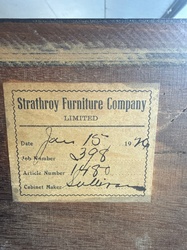
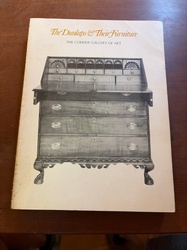
Limitations in authenticity verification are significant. Without physical inspection, I cannot confirm the wood type (solid vs. veneer), the exact construction methods (dovetailed drawers, etc.), or the extent of the damage at the base. I also cannot verify the presence of any manufacturer's marks or labels. In-person examination would allow me to assess structural integrity, the quality of joinery, and the true extent of wear and any necessary repairs. Provenance documentation or scientific testing (e.g., carbon dating for wood) would be needed for definitive age and origin authentication, though less common for items in this price range.