AI estimate as of September 6, 2025 · verify with a professional before acting
AI-Generated · Verify before acting
Everything on this page is generated by AI for informational purposes only. AI can make mistakes — the AI may misidentify items or misattribute them (artist, maker, brand, designer, origin, era). This is not an official valuation and should not be used for insurance, sale, tax, estate, legal, or lending purposes — or any decision requiring a certified appraisal. It is not an authoritative claim about any person, brand, or rights holder — do not share or rely on it as a factual statement about a third party. Always consult qualified professionals before making financial decisions.
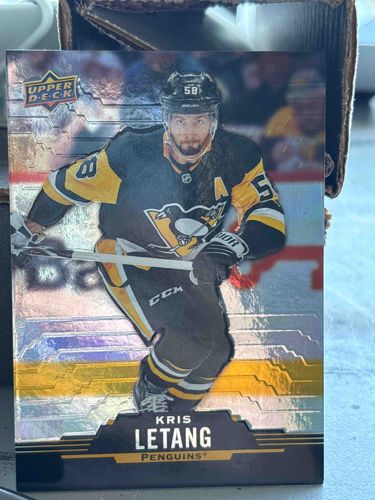
This item is a modern hockey trading card featuring Kris Letang, a prominent defenseman for the Pittsburgh Penguins. The card is rectangular, made of coated cardstock, and appears to be standard trading card size, approximately 2.5 by 3.5 inches. The primary colors are black, yellow, and white, consistent with the Pittsburgh Penguins team colors. The card features a clear, action-oriented photograph of Letang in his black and yellow Penguins uniform, wearing helmet number 58. The image quality is high, showing good detail in his facial features and uniform. The background of the card features a distinctive holographic or metallic foil finish with horizontal striped patterns, giving it a shimmering, reflective appearance that changes with light, indicating a special parallel or insert card. The 'UPPER D-E-C-K' logo is prominently displayed in the top left corner, confirming the manufacturer. Below the player's image, his name, 'KRIS LETANG', is clearly printed in a bold, sans-serif font, with 'PENGUINS' directly underneath, all set against a dark, layered base design. The card's edges appear sharp, and the surface shows no visible creases, tears, or significant dings, suggesting good to excellent condition. The glossy finish helps preserve the image and prevents smudges. The quality of printing and the inclusion of a holographic element suggest a higher-tier production designed for collectors. This card represents a modern era of sports memorabilia, likely from the 21st century, given the design and clear 'UPPER DECK' branding typical of contemporary sports cards.
AI Appraisal Report
Based on my visual examination of the provided image, this Kris Letang Upper Deck hockey card presents in good to excellent condition. The sharp edges, glossy surface, and absence of visible creases, tears, or significant dings suggest a well-preserved card. The prominent 'UPPER DECK' logo and overall design are consistent with authentic products from this manufacturer. The holographic/foil finish indicates a parallel or insert, which typically adds a slight premium over base cards.
From a market perspective, Kris Letang is a respected player, but his standard insert cards from relatively recent years do not command high prices unless they are serial-numbered ultra-rarities, autographs, or memorabilia cards. This appears to be a mass-produced parallel. Current market conditions for modern base and common insert hockey cards are generally low, with demand driven primarily by completionist collectors rather than significant investment potential. Comparable sales for similar Kris Letang Upper Deck parallels, un-graded, typically fall within a modest range.
Rarity is a key factor; while this is a parallel, it's not described as a limited-run or highly sought-after variation. Without specific set information (year, set name, parallel name), determining exact print runs is impossible.
Factors impacting value include player popularity (moderate for Letang), card condition (very good here), and scarcity (appears to be a mid-tier parallel). The biggest limitation in this appraisal is the absence of information regarding the specific set year or parallel name, which is crucial for precise valuation. Furthermore, this assessment relies solely on a visual image. For full authentication and a definitive condition grade, an in-person examination by a professional grading service (like PSA or Beckett) would be necessary to assess surface imperfections, corner sharpness, centering, and verify the holographic elements' authenticity. Provenance documentation (e.g., proof of purchase from a sealed product) can also add confidence in authenticity, though less critical for standard cards of this type.