AI estimate as of July 22, 2025 · verify with a professional before acting
AI-Generated · Verify before acting
Everything on this page is generated by AI for informational purposes only. AI can make mistakes — the AI may misidentify items or misattribute them (artist, maker, brand, designer, origin, era). This is not an official valuation and should not be used for insurance, sale, tax, estate, legal, or lending purposes — or any decision requiring a certified appraisal. It is not an authoritative claim about any person, brand, or rights holder — do not share or rely on it as a factual statement about a third party. Always consult qualified professionals before making financial decisions.
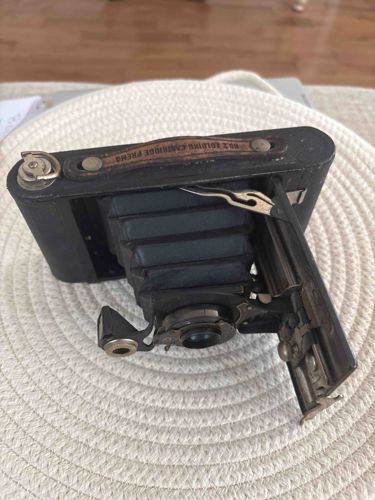
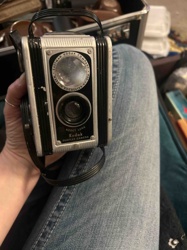
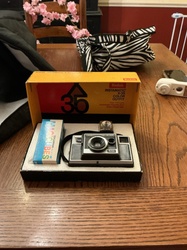
The item is an antique folding camera, likely from the early 20th century, given its construction and design. It features a dark, possibly black, leatherette covering over a rigid body, consistent with cameras of this period. The camera is in a partially open or extended position, revealing its bellows mechanism, which appears to be made of a dark, pleated fabric, possibly leather or a coated material. The bellows show some signs of compression and wear but seem to be largely intact, though their light-tight integrity cannot be fully assessed from the image alone.
One of the most notable features is the prominent brass (or brass-plated) strip across the top, which bears the embossed or stamped inscription “NO. 2 FOLDING CARTRIDGE PREMO”. This inscription identifies the specific model and manufacturer, 'Premo' being a line of cameras produced by the Eastman Kodak Company. The camera utilizes a folding bed design, where the front standard holding the lens and shutter extends forward on rails. These rails appear to be of a dark metal, possibly blued steel or oxidized brass, showing some areas of wear or patina.
The lens and shutter assembly are visible at the front, appearing to be a simple meniscus or achromatic lens within a basic leaf shutter mechanism. The metal components around the lens exhibit a dark, aged patina. There are various small metal fittings, levers, and fasteners, characteristic of mechanical cameras of this era, which show signs of age and possibly some surface corrosion or tarnishing.
The overall condition suggests significant age and use. The leatherette covering may have some scuffs or minor tears not fully visible. The metal components show expected wear for an item of this vintage, indicating a natural patina rather than severe damage. The quality of craftsmanship appears to be in line with mass-produced cameras of the early 20th century, aiming for functionality and portability. The precise age could be narrowed down further with research into the production dates of the 'No. 2 Folding Cartridge Premo'.
AI Appraisal Report
Upon visual examination of the provided image, I can confirm this is indeed a No. 2 Folding Cartridge Premo camera, identifiable by the prominent embossed inscription on the brass strip. This model was manufactured by Eastman Kodak in the early 20th century, specifically between 1904 and 1914. The camera exhibits typical signs of age, with its dark leatherette covering, extended bellows, and metallic components. The bellows appear intact, though their light-tight integrity cannot be definitively assessed without a physical inspection. Similarly, the lens and shutter assembly, while present, cannot be tested for functionality from the image. The metal rails and fittings show appropriate patina and wear consistent with an item of this vintage, not indicating severe damage. Authenticity based on visual cues appears strong.
Market conditions for early 20th-century folding cameras like this are generally modest. While there is a niche collector's market for vintage photographic equipment, common models from large manufacturers like Kodak are not particularly rare. Demand is moderate, primarily from collectors, photography enthusiasts, or those seeking decorative display pieces. Comparables for average condition Folding Cartridge Premo cameras typically range. Factors impacting value include the functionality of the shutter and lens, the condition of the bellows (pinholes significantly decrease value), and the overall cosmetic state of the leatherette and metal components. Serious collectors often seek working examples or those in exceptional cosmetic condition.
Limitations in definitive authenticity and condition assessment are significant without a physical examination. I cannot verify the integrity of the bellows for light leaks, the functionality of the shutter, the clarity of the lens, or the presence of any internal corrosion or damage. A hands-on inspection would allow for testing of mechanical functionality, detailed assessment of the bellows' condition, and closer examination of the lens and shutter. Provenance documentation, though rare for items of this commonality, would further solidify historical authenticity.