AI estimate as of August 9, 2025 · verify with a professional before acting
AI-Generated · Verify before acting
Everything on this page is generated by AI for informational purposes only. AI can make mistakes — the AI may misidentify items or misattribute them (artist, maker, brand, designer, origin, era). This is not an official valuation and should not be used for insurance, sale, tax, estate, legal, or lending purposes — or any decision requiring a certified appraisal. It is not an authoritative claim about any person, brand, or rights holder — do not share or rely on it as a factual statement about a third party. Always consult qualified professionals before making financial decisions.
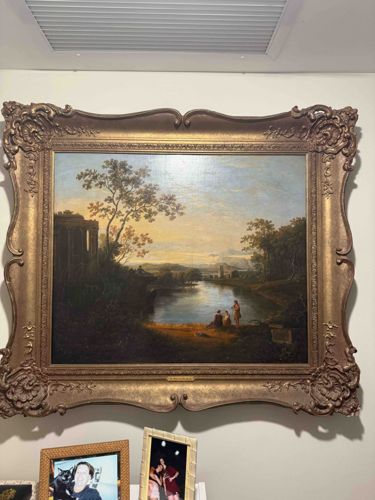
The item is an oil painting depicting a classical landscape scene, likely executed on canvas, framed within an ornate, possibly gilded, wooden frame. The painting portrays a serene riverside setting with lush trees, classical ruins on the left bank, and what appears to be a town or settlement with architectural features in the distance on the right bank. The sky transitions from a soft yellow-orange hue near the horizon, suggesting dawn or dusk, into a lighter blue sky overhead, with visible cloud formations. In the foreground, near the water's edge, several small figures are depicted, suggesting a pastoral or recreational activity. The colors used are generally muted and naturalistic, with greens, browns, blues, and earth tones dominating the palette. The brushstrokes appear relatively smooth, indicative of a more traditional academic or classical painting style.
The frame itself is a significant feature, characterized by elaborate rococo or baroque-inspired foliate and scroll carvings, particularly prominent at the corners and along the top and bottom edges. The color of the frame is a distressed or antiqued gold, contributing to a sense of age and grandeur. There are visible signs of wear and age on the frame, including minor nicks, chips, and areas where the finish may be worn, revealing hints of underlying material, possibly gesso or wood. The condition of the painting itself appears good, with no obvious major damage like tears, punctures, or significant paint loss visible from the image. However, a slight reflection on the surface suggests a varnish layer may be present, and minor surface grime or craquelure is possible given its apparent age. The overall craftsmanship of both the painting and its frame point to a work of considerable quality, likely dating from the 18th or 19th century, consistent with the classical landscape tradition.
AI Appraisal Report
This classical landscape oil painting, housed within an ornate gilded frame, presents as a charming example of 18th or 19th-century artistry. Based on my visual examination, the painting appears to be in good overall condition, with no overt signs of tears, punctures, or significant paint loss. The colors retain their vibrancy, and the brushwork suggests a skilled hand. The frame, a significant component of this piece, exhibits appropriate wear consistent with its age, including minor nicks and areas of worn gilding, which contribute to its antique charm rather than detracting from its value.
Market conditions for classical landscapes remain steady, with demand for well-executed examples in good condition. The presence of figures and architectural elements adds narrative interest, enhancing its appeal. The ornate frame further elevates its aesthetic and perceived value.
However, it is crucial to state that my assessment is based solely on the provided image. Authenticity verification from images alone is inherently limited. To confirm the artist's identity, period, and full authenticity, an in-person examination would be essential to assess brushwork nuances, pigment analysis, and the canvas's stretcher or support. Provenance documentation, such as exhibition history or previous ownership records, would significantly enhance value and authentication. Scientific testing, like UV light examination for restorations or infrared reflectography for underdrawings, could provide definitive insights into its condition and origin. Without these, the attribution remains broad.