AI estimate as of December 3, 2025 · verify with a professional before acting
AI-Generated · Verify before acting
Everything on this page is generated by AI for informational purposes only. AI can make mistakes — the AI may misidentify items or misattribute them (artist, maker, brand, designer, origin, era). This is not an official valuation and should not be used for insurance, sale, tax, estate, legal, or lending purposes — or any decision requiring a certified appraisal. It is not an authoritative claim about any person, brand, or rights holder — do not share or rely on it as a factual statement about a third party. Always consult qualified professionals before making financial decisions.
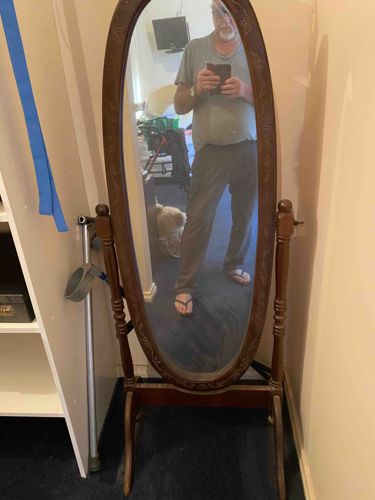
This is an oval-shaped cheval mirror featuring a wooden frame and stand. The mirror itself is housed within a dark-stained, possibly walnut or mahogany, wooden frame that is intricately carved with a repeating floral or foliate motif along its inner edge. The carving adds a decorative element to the piece, suggesting a classical or traditional design influence. The mirror is supported by a freestanding cheval stand, which allows the mirror to pivot and be adjusted for different viewing angles. The stand consists of two vertical turned posts on either side of the mirror, each terminating in a finial at the top and extending downwards to form splayed legs for stability. These posts are also made of a dark-stained wood, matching the mirror frame, and exhibit some turned details. A horizontal stretcher or crossbar connects the lower portions of the splayed legs, enhancing the structural integrity of the stand. The overall construction appears solid, indicating a piece of furniture made with traditional woodworking techniques. Visible condition issues are minor, mainly consisting of some light wear and possibly a few superficial scratches consistent with age and use, particularly on the wooden frame and stand. There are no obvious signs of significant damage, repairs, or deterioration of the mirror's silvering. The finish on the wood shows a consistent dark patina. The style period is likely late 19th to early 20th century, possibly Victorian or Edwardian revival, given the ornate carved details and cheval stand design. The craftsmanship appears to be of good quality, with attention to detail in the carving and turning work.
AI Appraisal Report
Based on my visual examination of the provided image, this Oval Cheval Mirror with Carved Frame appears to be a well-preserved piece, likely dating from the late 19th to early 20th century, consistent with Victorian or Edwardian revival styles. The intricate floral/foliate carvings on the dark-stained wood frame (possibly walnut or mahogany) and the turned details on the cheval stand suggest good quality craftsmanship for its period. The overall condition looks favorable, with only minor wear, light scratches, and a consistent patina, which are expected for its age. There are no indications of significant damage, repairs, or silvering deterioration from the image.
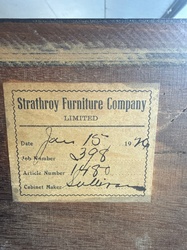
Market conditions for antique cheval mirrors vary, with highly ornamented, well-preserved examples fetching better prices. While this piece possesses decorative appeal, it is not of exceptional rarity or from a highly sought-after maker (which cannot be determined from images alone). Demand is moderate for such functional decorative antiques, generally from buyers looking for classical or vintage interior accents. Factors impacting value positively include its good condition, the detailed carving, and its functionality. Conversely, the lack of a known maker, typical age-related wear, and the general availability of similar period pieces prevent it from reaching a higher valuation.
My valuation of $400-700 is based on these observations. For full authentication, I would require an in-person examination to assess the wood type, construction methods (e.g., joinery), and the mirror's silvering more closely. Physical inspection would also allow for a more precise evaluation of the extent of wear and any potential unseen repairs. Provenance documentation, if available, would further solidify its age and origin.